Stories for Survival

These days, knowing one’s rights and what supports might be available can be life-changing or even life-saving. As an organization, getting facts and actionable steps out to your community is imperative

Even more imperative? Getting that information out in a way people can understand and remember. 

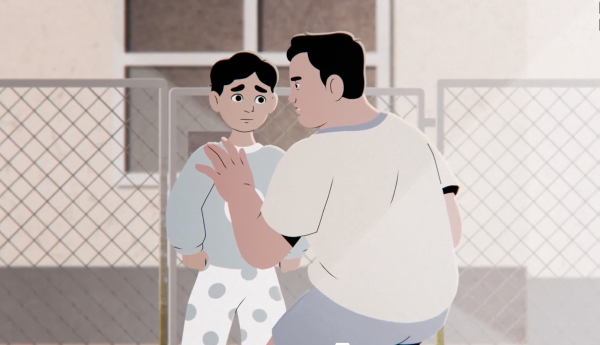
The team behind WeHaveRights.us has achieved this brilliantly. In 2018, the ACLU and Brooklyn Defender Services released a series of four videos created in collaboration with MediaTank Productions and a fifth in 2020. The series is meant to inform people of their rights when interacting with Immigration & Custom Enforcement agents (ICE). Each video shares dos and don’ts: Be prepared for encounters. Do not show any documents. Document arrests. And, each  guideline is embedded within a personal story. 

Take a moment to watch the videos (they are each just a few minutes long), and you will see how the narrative moments give the instructions clarity and a sense of urgency.

Michael Kleinman, the founder of MediaTank Productions, co-wrote and co-directed the episodes. Kleinman told us about the inspiring success of the campaign.  

“The videos have been viewed tens of millions of times since their release. Notably, millions of views have come in 2025, nearly 7 years after the initial launch, proving their durability as a tool for information. The videos benefited from partnerships with major media outlets and hundreds of nonprofit partners who participated in the campaign as well as celebrities who lent their voices and platforms to the project, including Jesse Williams, Kumail Nanjiani, Diane Guerrero and Fiona Apple.”  

What made these episodes resonate so much with viewers? Their use of story. Michael told us, “We decided to couch the vital information we were providing to viewers in human stories for several reasons – the dramatic narrative structure made the videos more engaging, which allowed for a wider reach and greater shareability while also making it easier for the viewer to retain information. Because the stories we used were all based on real world examples of encounters with ICE, they also provided viewers an emotional window into what is happening in communities across the country. In creating the stories, we worked closely with immigration lawyers and undocumented communities to ensure the storylines were accurate and that they connected with our target audiences.” 

Whether sharing information about funding losses, language changes your communities might need to know for grant forms, or how to participate in your programs, don’t leave stories at the door.

When you have instructions to share with your partners, clients, and communities, connect information to real human experiences. Stories are a doorway to engaged learning. 

Finding the Humanity in Complicated Laws: Learning from The Nature Conservancy

Federal legislation such as the Farm Bill or the Inflation Reduction Act (IRA) can be so complex that it’s difficult even for lawmakers themselves to understand how these laws will affect people at ground level. Realizing this, The Nature Conservancy’s (TNC) policy communications team decided to capture those first-person stories and bring them back to Washington, D.C.
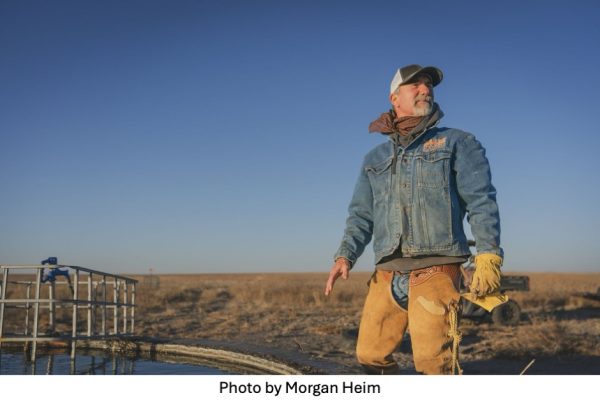
The results are “Harvesting Hope” and “Decade to Deliver,” two collections of stories that vividly illustrate the real-world impact of provisions in the Farm Bill, IRA, and the Infrastructure Investment and Jobs Act (IIJA) – massive policies that support climate action and conservation.

In November, I had the chance to interview the leaders of these projects at TNC, Jill Schwartz and Eric Bontrager, who shared some of their experiences in developing, specifically, the Harvesting Hope series. Their observations provide useful guidance for anyone who deals with complex legislation, systems change, or other abstract subjects that may be missing the human touch.

Kirsten: How and when did this project begin?

Eric: Harvesting Hope focuses on the Farm Bill, which is America’s largest investment in the voluntary conservation, restoration and management of America’s private lands. It’s a major policy focus for TNC, and our work on the latest version of the bill—last passed in 2018—began in early 2023. We had just finished developing our Farm Bill policy platform. At the time, we had a new Congress that had come in, and we also had some funding to explore potential storytelling. This was a chance for us to make this real personal connection to the Farm Bill for lawmakers, but also see to what extent could we really [use] storytelling. We’d done it in pieces, but we had never really done it in this kind of large, concentrated way. This is about the time that Jill came in, and her big focus has always been on storytelling.

Jill: When I was interviewing at TNC last year, I asked them, “What’s the main thing that you need?” And they said, “Stories about people who benefit from federal policies.” When I got here, I found out that [some] people were actually thinking of project overviews instead of stories. There was a little education to be done. We had to “show, don’t tell.” Show people what we mean by people-centric stories. So, my team just started producing stories [that] focused in on one person, and then we started publishing them and sharing them internally and externally, and they were very well received.

Kirsten: How did you go about gathering the stories for Harvesting Hope?

Eric: That was the biggest hurdle for this project. We had to find somebody who had a connection [to the storyteller], and we wanted them to be nested in the different categories we needed — so somebody for conservation easement, soil health, forestry, etc. We wanted them to be compelling stories, but we also wanted to be both geographically and demographically diverse. That’s where you may not have as extensive a network or as diverse a network as you want. So, it was a lot of cold-calling. It was a lot of reaching out to our networks and talking to our chapters and then doing a lot of interviews with potential subjects. I would say that was a lion’s share of the initial work.

Jill: There was a lot of calling one person and then they direct you to another person who would direct you to another person, but we would eventually get to the people who work on the ground. You have to go down the org chart to find those people.

I was new and most of my team was new, and so we just didn’t really know who to go to. It’s such a big organization that just finding the people who are in the field and know the actual cast of characters is hard. But then the other thing was just realizing that not everybody knew what we meant by “story,” and they were giving us themes, not actual stories that had a central character. That’s when we brought in The Goodman Center to lead several storytelling workshops, which were incredibly well received to help people understand what a story is. Not because we were asking them to write the story, although we welcomed that. It was more [that] we wanted them to be the eyes and ears for potential story ideas related to the Farm Bill, as well as the IRA and IIJA (the focus of our Decade to Deliver story series). They could only do that if they knew what we meant by story. And so, if they could find the ideas and pass them on… we could pursue them.

Kirsten: We appreciate the plug. How difficult was it to strike a balance between finding compelling stories and being strategic about the content of the stories?

Jill: For the Harvesting Hope project, we knew we were going to do five story packages about the Farm Bill. Originally, we thought, let’s find the congressional leaders who we really need to influence to get the Farm Bill passed, and we’ll just do one story in each of their districts. Well, we had to take that off the table as criteria because it was just another level of complexity. So, we then tried to find people in certain states where the congressional person might live, but even [that wasn’t working].

We eventually decided if we have a good story, it’s going to inspire somebody no matter where they live. Then, we were also mindful of finding people who had tapped into different programs. We also looked for diversity in terms of age, gender, ethnicity, location and the type of agriculture being done.

Eric: We know that there is power in storytelling, especially with lawmakers who may not have a good versatility on a particular policy issue. My personal goal for this – it’s not like a metric or anything – I would love to have one lawmaker mention one of our stories on the House or Senate floor during debate. If they did that, I’m done. I have achieved my objective!

Kirsten: That would be incredibly gratifying, I’m sure. So, what have been some tangible successes so far?

Eric: In September, we had an event in Washington, D.C. where we showed the first four Harvesting Hope videos (each story package for this project includes video and written content). We invited congressional staffers, as well as TNC trustees, donors and staff from the D.C. area. It was the first indication of the effectiveness of this because people were really receptive. They had a lot of questions. We actually had some of the farmers, ranchers and foresters in the films as speakers for a moderated discussion with the head of our North America region. The engagement was just unbelievable.

Jill: There has been such phenomenal acceptance of these stories at the organization. In fact, at her recent town hall with staff, our CEO spoke several times about the importance of storytelling, especially over the next four years.

But I think what I’m most proud of is the first person we interviewed for the “Harvesting Hope” series, Treg Hatcher. He’s a rancher in Kansas, and when I sent him the written story and draft video to review, two things happened. One is he said, “I never really realized I had a story to tell.” And second, he has become so proud of his story that he was willing to come to Washington, D.C. for the day with his son and lobby on Capitol Hill for the Farm Bill with us. Since then, his son, who appeared in the film, has come back a second time to do that.

Helping people understand that they have a story to tell is really, really rewarding because you know in the end we’re doing advocacy. We’re trying to affect change. And  if we can inspire somebody to be a public champion for our cause, that’s a huge win.

I don’t want to just write stories to write stories. I want to write stories that actually can change things. So the fact that he we now had a rancher from Kansas who’s willing to come to Washington, DC, and lobby for the Farm Bill was huge.
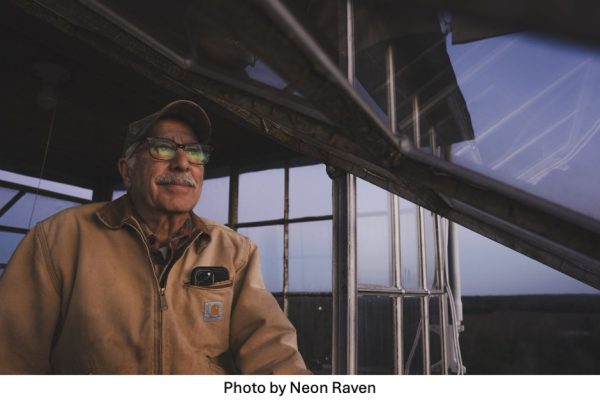
Eric: [Our storytellers are] excited about their stories, which makes me feel like we were good custodians of their stories. Not only were they happy about it, they wanted to do more. They wanted to get more involved. For me, probably the biggest win was that we were caring for their story. That was of paramount importance to all of us.  

We’re very protective of these stories because these are people who are literally opening up their lives to us and their hardships. The Hatchers were about ready to lose their ranch. Saloom lost hundreds of thousands of dollars worth in timber. You have to be very respectful of the story. Doing the legwork that we did beforehand, like pre-production trips, is important. We’re not going to just stick a camera in front of you. We’re going to meet with you when there’s no pressure. It’s not on the record. We just want to get a sense of who you are and make that personal connection. That helped create more authentic stories and a better filming experience later.

And then there is follow-up. We would share drafts with them as they got closer to the final, just to make sure that we were accurately reflecting their stories. It was definitely a collaborative effort. I still talk with one of the subjects all the time, just texting back and forth.

Kirsten: What is next for these stories?

Eric: One of the things that we talk about a lot is that [storytelling should be] 40% production, 60% distribution. So, my big focus right now is trying to figure how can we get these out there.

Kirsten: Jill, I remember you talking about the 40/60 rule before. Can you talk more about the plan for distributing stories?

Jill: Part of it is internal distribution. We still work within our organization to help people  understand why policy matters and what we even mean by policy. So, anytime we have a story come out, we have a list of 20 or so internal newsletters or e-mail lists that we can we send the stories to for inclusion in those. That’s been giving us a lot of great exposure.

When our policy people are making a presentation internally, we encourage them to tell an anecdote from one of those stories, or maybe even tell their own story.

Externally, we have been able to get some of the stories into TNC’s external facing newsletter which goes to hundreds of thousands of people. We’ve gotten a few of them into the magazine which is also well distributed, and then we’ve been working on getting them into partner organizations, if they have a website or a newsletter or on social media.

We’re just starting the process of trying to get [the films] into some festivals. As we said, we hosted a film screening where we showed the first four of our five “Harvesting Hope” video stories, and that was really successful. So we’re probably going to do some more of those around the country.

Kirsten: Sounds like I will have to follow up next year to find out more about the long-term impacts of this storytelling campaign!

Please check out the written and filmed stories for Harvesting Hope and Decade to Deliver.

Thank you so much to Jill Schwartz and Eric Bontrager for taking the time to talk storytelling with me. Jill is the Director of Marketing and Communications, North America Policy and Government Relations, and Eric is Associate Director of Communications, North America Policy and Government Relations. The Goodman Center has been honored to work with the policy team, government relations teams and more at The Nature Conservancy over the years.


Tools to Build Connection and Strength During Times of Upheaval

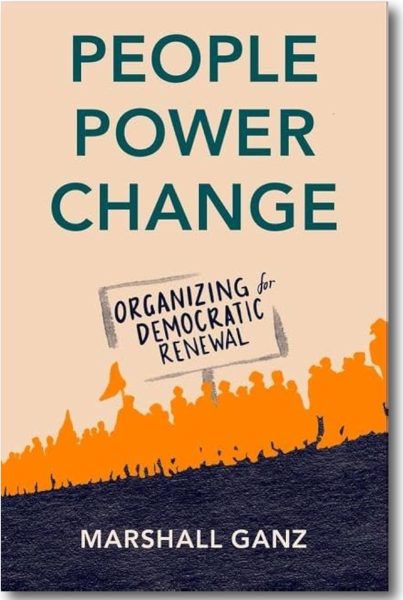
Public interest communications is the work of transformation. Creating a safe, just, and equitable world requires us to transform apathy into caring, caring into action, and action into deep lasting change. Marshall Ganz’s new book, People Power Change: Organizing for Democratic Renewal, provides a framework to build your craft of connecting hearts (caring), heads (strategy) and hands (action). The lessons within are both practical and inspiring: a winning combination.

I’ve been fortunate to take classes with Ganz, and reading this book was like sitting in those classes. So, if you don’t have the time for an intensive 3-month virtual class at Harvard, this book is for you.

Here are my top takeaways, which will hopefully convince you to make this your winter read:

Create connection by listening to and telling stories.

Whether you are building and strengthening community grassroots-style, or you’ve earned your way into a billionaire philanthropist’s office, stories remain the number one tool you have for creating meaningful connections and relationships. Being able to articulate your story and the story of your organization is important, but equally valuable is having the tools to listen and draw out the story of the person you are meeting. What are the values that intrigue them about this work? What are the experiences that have made them care?

Ganz’s teaching on public narrative is invaluable for making a connection at the heart level with your partners and donors that will last past this giving season.

Image generated with the help of AI.

In times of change and loss, build an empathetic bridge.

Our organizations, communities, and countries go through periods of uncertainty and even devastation. How can we shepherd our teams and constituents through times of loss and upheaval?

Whether it is a loss at a leadership level, big changes in organizational structure, funding, or laws that affect our work, Ganz’s concept of the “empathetic bridge” reminds us that first and foremost we must acknowledge the change and the emotions that go along with that. Rather than rushing to action, we should harness the emotional resources that arise through processing frustration, anger, and sadness.

I think of this like gasoline (if you’ll forgive the fossil fuel metaphor). Frustration, anger, sadness, rage – these are fuel to create change, but not if we spray them out into the air. We need to aim the gasoline into our engines to get where we are going.

Don’t fall flat on your ask.

If you’ve attended a Goodman Center Strategic Communications webinar, you’ve heard us say this before. If you have managed to turn that apathy into care and have a potential donor, partner, or volunteer pumped up and ready to get to work, you must have an action for them to take that they can commit to. You also must be able to convince them that this action will make a difference.

In his chapter about action, Ganz digs into the process of securing commitments from our partners. “The key is not making it an easy ask but rather in making a valuable ask.” What difference will it make if I sign up for your newsletter? How do I know that my $5, $50, or $5,000,000 is going to have a real impact if I give that to you? This is about offering proof with story and data and seeing a request to commit not as a burden but as an investment in a better future. Our audiences want a chance to make the world a better place. You are offering them that very thing. Do they know how it works?

The wisdom in People Power Change is speaking directly to organizers and social justice movements, and I believe that the same craft used for building those communities can be harnessed into a force for good by anyone working to transform our world.

Need Hope? Tell Stories.

I was recently asked to keynote the Princeton Community Works annual convention, where hundreds of nonprofits and all sorts of do-gooders gather to learn how to deepen their impact. This year’s theme: Making Hope a Reality.

When I heard that theme, I thought, “OOOOH!” I immediately accepted the offer. I was hooked. It felt good. Hope. A keynote about hope. I went to sleep that night imagining spirits lifting, creativity blossoming, angels singing. In the morning I had a bit of a hope hangover.

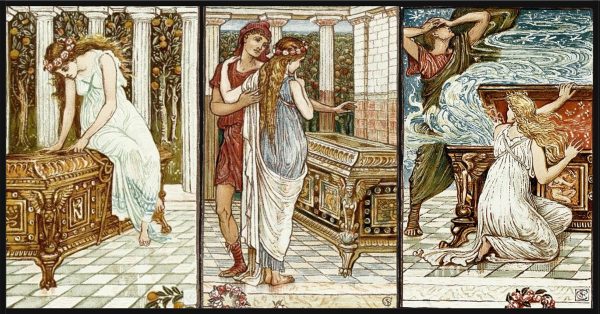
As I read through the headlines on NPR.org, a familiar feeling of “Ugh. Everything is terrible” sank down in my gut. How am I supposed to talk about hope if I’m not feeling any?A few hours later I asked a friend for advice, but, instead, I got a warning. “Did you know that in Greek mythology, hope is one of the things inside of Pandora’s box?” You know, hanging out with sorrow, disease, vice, violence, greed… your basic miseries. The Greeks were not the only ones to tie hope to calamity. In our modern mythology, created out here where I live in Hollywood, here is a smattering of how we talk about hope:

“Let me tell you something, my friend. Hope is a dangerous thing. Hope can drive a man insane.” The Shawshank Redemption

“Hope is a mistake.” Mad Max, Fury Road

“Hope don’t get the job done.” Roman J Israel, Esq.

“I found freedom. Losing all hope was freedom.” Fight Club

“A little hope is effective, a lot of hope is dangerous.” The Hunger Games

“There is a reason why this prison is the worst hell on earth… hope… I learned here that there can be no true despair without hope.” The Dark Knight Rises

All of a sudden, I’m thinking agreeing to this was a mistake. But even though I was overwhelmed with the dark side of hope, there was still something in me saying, “Hold up, Kirsten. Hope is necessary. Hope is fuel for driving social change. I think hope is awesome, right?”

Then I found Dr. Chan Hellman’s TedTalk, The Power and Science of Hope. What struck me most was his definition of hope. “Hope is the belief that your future will be better than today and that you have the power to make it so.”
He says hope is different than wishing, optimism or desire. It isn’t just the belief in something better. Hope requires the pathway to get there. Cinderella is a story about wishing not hope, because, though she desires to go to the ball, Cinderella has no agency to make it happen. It takes a fairy godmother.

Let’s say your organization has clearly illustrated the problem you want to solve with urgency and emotion but hasn’t shown the audience a pathway to the better world you envision. Well, you’ve just depressed everyone. “There’s this problem, but not much we can do about it. Let’s all go home.”

If you want to create communities to participate and advocate for change, building hope is a necessity, and telling stories is the best way to build it.

So, where do we get these stories and how do we tell them? There is a misconception about where hope lives. People think hope is all about the future, but the surprising truth is that hope is found in the past. How do we know we can build a better world? Because we have done it before. And we can tell you that story.

We call these success stories or impact stories. They are the proof that we can create our vision. We have already made the world healthier, more equitable place in partnership with this community, family or individual, and here’s how we did it.

It is essential we tell stories of hope to our communities so they can experience what is possible and join us in making it so. We must tell our stories to each other to prevent burnout. Often in our work we witness overwhelming injustice and need. Stories of hope remind us we can make a difference together. We are already doing it. Let’s even tell our stories to ourselves because sometimes those NPR headlines make us want to crawl under the covers.

It may sound like chicken-and-egg logic, but when we tell stories of hope, we create hope. That hope gives people the power and will to create positive change. Which creates more stories of hope. Not sure where the cycle starts and ends, but I’d sure like to be in that cycle. Wouldn’t you?

If you want to learn more about how to craft these stories, then, my friend, you are in the right place.

Brilliant Ideas to Build a Storytelling Culture for Fundraising

As the Executive Director of Pinky Swear Foundation, Erica Neubert Campbell knows one of her main roles is fundraising, but she doesn’t consider herself to be a fundraiser. Instead, she is Pinky Swear’s “Storyteller in Chief.” Erica has found that telling stories and developing a storytelling culture at the foundation has been the best way to build relationships, spark interest and solidify commitment with potential supporters.

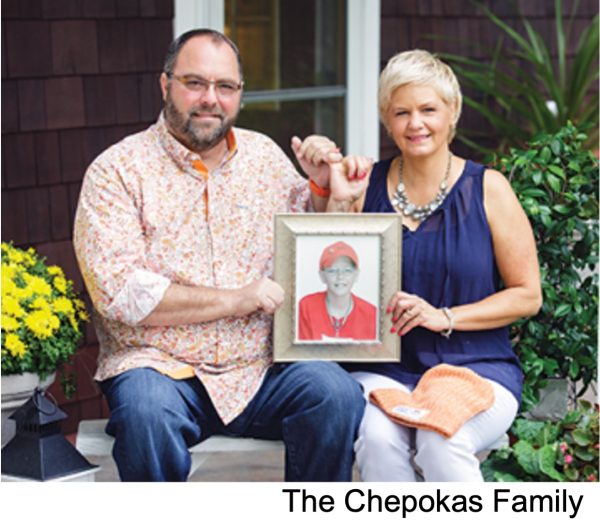
A man in a peach flowered shirt sits on the left of a woman with short white hair. They hold a picture of their son wearing a red shirt and baseball hat. Over the picture they hook pinkies.The first story you are likely to hear about Pinky Swear, is their origin story: 9-year-old Mitch overhears a family talking about not being able to afford Christmas presents. Mitch decides to empty his bank account and share all he has with the families who are in the cancer ward at the hospital where he is receiving treatment for bone cancer. Mitch asks his father to ‘pinky swear’ to do the same the next year, after Mitch is gone. You can see the story here – bring tissues.

Building on a beautiful foundational story, Erica and her amazing team knew they could reach the hearts and minds of donors, volunteers, staff, and community members by improving their own abilities to share powerful stories. Here are two brilliant ways they have done just that:

Story at staff meetings

an overhead view of 4 people sitting at a table having an office meetingAt least once a month at staff meetings, the Pinky Swear team does an exercise led by All-Star Engagement Manager, Sue Ratcliff. Sue’s role at Pinky Swear is to connect with families who are battling cancer (who they call “All Stars”). For the team exercise, Sue will share information from an interview with a family, write up a story version, and then each staff member will practice sharing the story. They don’t read it word for word. Instead, they practice telling it in their own words; how they might share it with a potential donor or supporter. This way the story won’t feel like a canned speech but will come from the heart.
Erica says having every member of the staff practice storytelling is a huge part of their culture of philanthropy. “Whether you are an office assistant, accountant, or lead fundraiser, you have an important part to play in fundraising and philanthropy.” Story practice enables every member of the staff to communicate what they do through a story of impact.

The story tour

Sometimes donors and potential donors come by the office at Pinky Swear for a meeting or tour. They want to see what the foundation is all about, but they have a rather small office filled with cubicles. How could this inspire donors?

Lacey Kraft, Vice President of Philanthropy, came up with a game-changing way to give an office tour. She envisioned story stations that were set up strategically to create a flow through their office. By the time you finish the tour, you understand the Pinky Swear Foundation mission and are enamored with not just what they do, but how they do it.

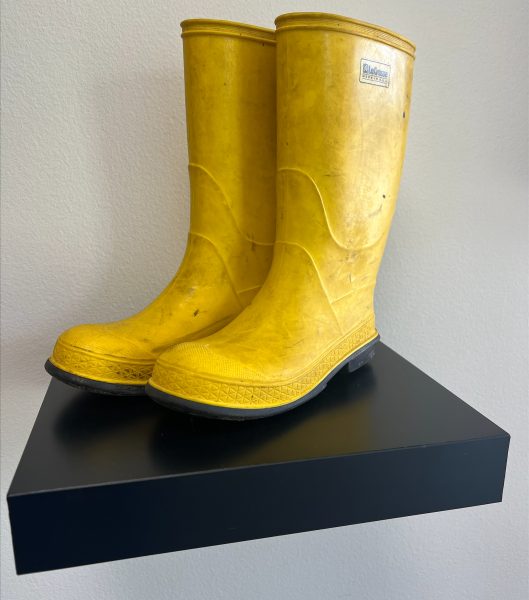
A used pair of yellow rain boots is displayed on a black shelfI got to take an abbreviated version of the tour via Zoom. Erica started by bringing me to “Mitch’s Corner.” This is a collection of Mitch’s memorabilia, like his yellow rain boots, a fireman’s hat and Wheaties box. There is a story about each item.
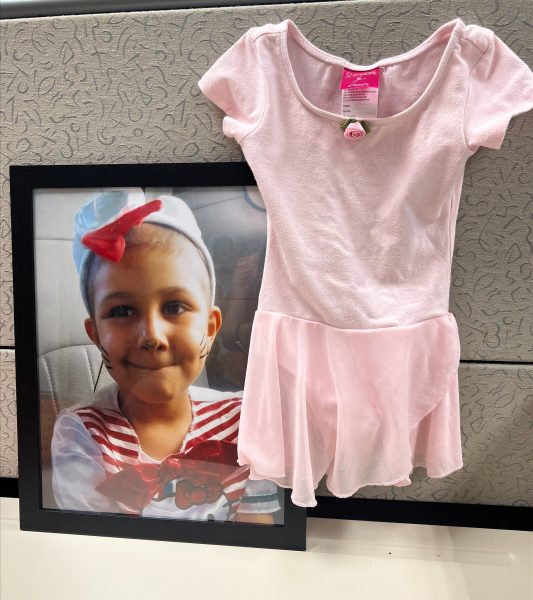
Next to Mitch’s Corner, a small pink leotard lays over the back of a kid’s chair next to a picture of Victoria. Victoria’s mom got a phone call about her daughter’s cancer diagnosis right after a dance class. So, they rushed to the hospital with Victoria still wearing her blush pink leotard.
When a donor interacts with each object, the story of these kids and their families become visceral and emotional. When I saw the mud that is still on the bottoms of Mitch’s yellow rain boots, right away I imagined him splashing and laughing in the rain. I felt connected to him.

Across the office is another station where they put together their Orange Envelope program. This program is often the first connection they make with a family battling childhood cancer. The staff stuff these envelopes with gift cards for immediate needs, a guide to resources and words of support. Right next to the big orange envelopes is a photo of James, so whoever is giving the tour can connect the impact of this program through James’s story.

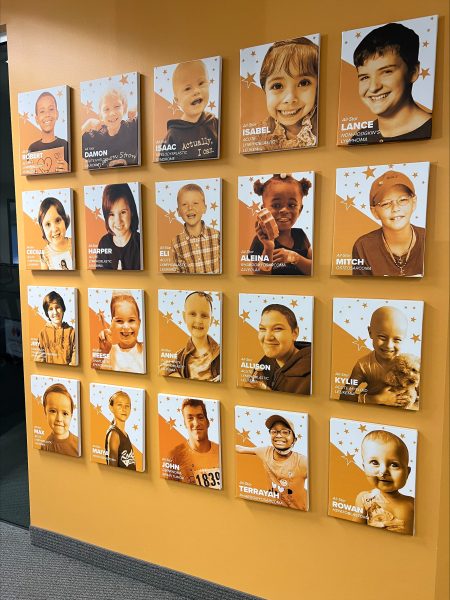
A mustard colored wall is decorated with 20 pictures of adorable smiling kids.The tour isn’t over yet! There is a wall of pictures of several kids the foundation has worked with. The tour guide can ask which picture speaks to you, and then they can tell the story of that kid and their family: who they are, what their goals and dreams are and how Pinky Swear is supporting them every step of the way.
The Pinky Swear Foundation has been very strategic and purposeful about putting storytelling to work. When asked why that is, Erica makes it sound like a no-brainer. “We realized that’s where we get the most traction. People come and they are genuinely moved.” Erica sheepishly admitted she doesn’t always add a financial ask to the end of the story. Oftentimes, she doesn’t need to. After taking the tour and hearing the stories, people reach out to her to find out more about how they can support the work.

The Pinky Swear team has also found that the families they have served value their stories being seen and heard. They love telling their stories and see that as a way to support the organization that supported them during a difficult time.

If you want your organization to become a storytelling culture, borrow these great ideas from Erica and her team: tell stories at staff meetings and make them part of your office tour. I promise, you will create lasting connections with your supporters. In fact, I pinky swear.

Five Faves from frank

The frank conference, convened each February at the University of Florida and curated by the Center for Public Interest Communications, is always an extraordinary gathering of artists, activists, academics, and changemakers from around the world. This year’s 10th edition, unified by the theme “The Long View,” was no exception. If you couldn’t attend in person or join online, your second chance has just arrived: videos of all the mainstage speakers have been posted on the web, and you can find them here.

In the less-is-more spirit of TED conferences, all the talks are relatively short (generally running between 10-15 minutes), and all 30+ recordings are worth watching. If that feels overwhelming, we recommend starting with the following five presentations that do what frank does best: entertain, inform, and inspire you to follow the frank credo, “Don’t settle for small change.”
“How To Be an Abolitionist,” by Tanya Watkins

Tanya Watkins is the Executive Director of Southsiders Organized for Unity and Liberation, better known as SOUL. (Full disclosure: having seen Tanya speak before, we recommended her for this year’s frank, so we were already fans.) Tanya self-identifies as a “prison abolitionist,” and in this talk she tells you what it means to be an active part of that movement, and why her encounter with the legendary activist Dr. Angela Davis changed her understanding of how we get justice in America.

“The Great Stewardess Rebellion,” by Nell McShane Wulfhart

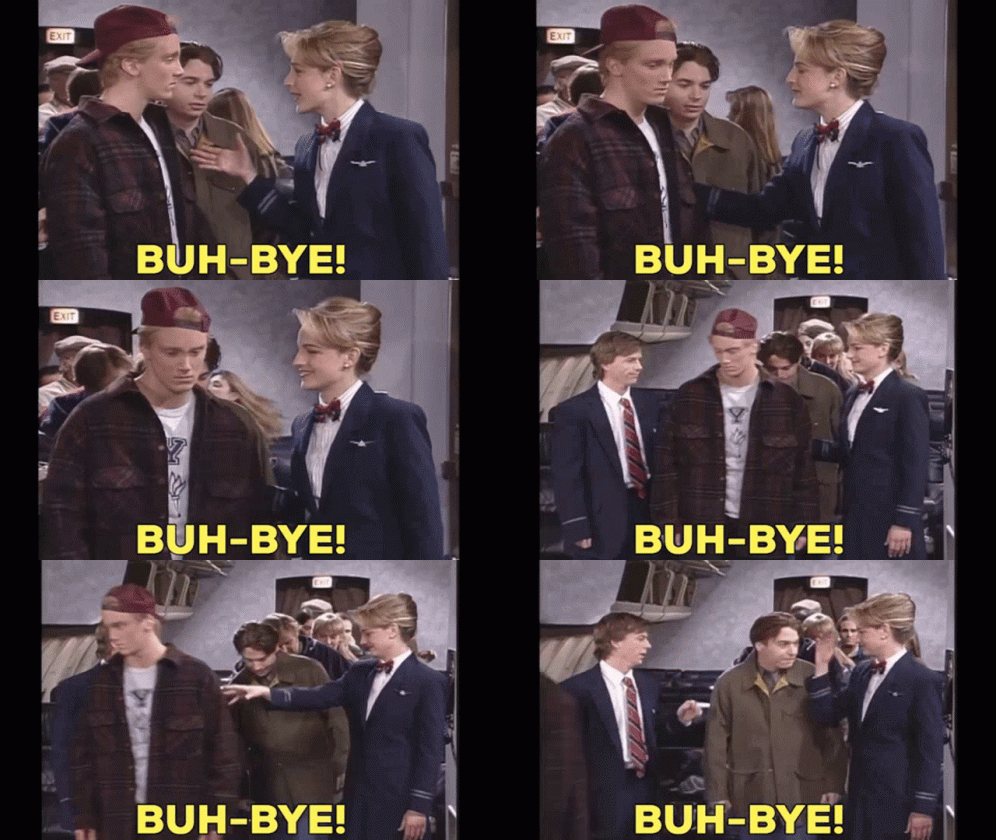
If you wanted to be a stewardess in the 1960s, you had to be young, pretty, trim, and single. And should any of those things change, you could be fired faster than you could say, “Buh-bye!” None of that would be accepted today, but remember this was the heyday of high-flying Mad Men and a low point for the rights of working women. In this talk based on her book, “The Great Stewardess Rebellion,” Nell McShane Wulfhart tells the under-appreciated story of how airline stewardesses led a worker’s revolution that changed labor laws and advanced the rights of working women everywhere.

“Mind Your Metrics,” by Dessa

Squinting at spreadsheets. Pouring handmade lipstick into tubes. Negotiating over the price of trailers. This is the life of a musician? It has been for Dessa, a supremely talented singer and writer who, like so many others trying to make it in today’s music business, must do everything by herself. For Dessa, metrics such as the number of likes on her Instagram account or the amount of t-shirts sold – things that have nothing to do with being an artist – they not only measure what she does, they start to define it. And it’s not a definition she can accept. Business guru Peter Drucker famously said you can only manage what you can measure. Dessa asks us to consider the opposite: is what you are measuring managing you?

“The Playbook,” by Jennifer Jacquet

In real life Jennifer Jacquet is a Visiting Professor at the University of Miami and an Associate Professor at New York University. For the purposes of her satirical talk at frank, however, she pretended to be a representative of J.J. & Friends, a PR firm that works with corporations whose toxic products are killing people and/or the planet and helps them sow doubt, distract, and outright lie about the damage they are doing. In laying out strategies from the same, playbook that has already served tobacco, oil, and chemical companies so well, Jennifer helps us understand what we can do to fight the lies and disinformation being circulated today.

“Turn Your Rage Into Inspiration” by Rick Serdiuk

Rick Serdiuk is the Creative Director of the Ukraine-based ad agency Banda. The day that Rick spoke at frank was just short of the first anniversary of the Russian invasion, an event that has gradually receded from the consciousness of most Americans, but, as Rick reminded us, remains a defining moment for Ukrainians. In this powerful and moving talk, Rick helped us understand how the Ukrainian people are essentially wheat farmers who, as he put it, are occasionally forced to become falcons who must fight to protect their very identity. He shared some of the creative campaigns his agency launched to keep morale high during the war (most notably the “Be Brave” campaign which circulated worldwide), and by the end of his talk, Rick made sure we understood why Ukrainians proudly call their homeland “the f*** around and find out country of Eastern Europe.”

Why We Win Hearts and Minds (Not Minds and Hearts)

In this month of hearts, it seems fitting to focus on the role emotions play in connecting your audience to your cause. How can your comms efforts have the power to compel action? How can you get your audience to donate, to volunteer, to vote – even just to pay attention? How do you win hearts and minds?

Let’s take a moment to consider that phrase itself. There is good reason it is “hearts and minds” and not “minds and hearts.” The pervasive attitude since Descartes famously coined, “I think therefore I am” has been that humans are rational beings who have feelings, but experts like neuroscientist Antonio Dimasio and anthropologist George E Marcus have been making claims that turn Descartes on its head.

Marcus, in his paper The Sentimental Citizen: Emotion in Democratic Politics claims that reason itself relies upon emotion to determine what to respond to, what is central and vital to us and to initiate and manage action. Or as one of my favorite experts, Andy Goodman, always says “If you don’t care, you don’t do.”

In public interest communications, we have to win their hearts in order to access their minds and help them make the decision to sign up or show up. We need to give them all the feels.

Science backs me up on this, too. In their paper Emotion and Decision Making, Jennifer S. Lerner, Ye Li, Piercarlo Valdesolo, and Karim S. Kassam state that “The research reveals that emotions constitute potent, pervasive, predictable… drivers of decision making.”

If you want your outreach to be potent, pervasive, and persuasive, you are in the realm of storytelling. Neuroscientist Paul Zak has shown in his lab that storytelling has the power to release oxytocin in the brain of the listener or watcher. Oxytocin is a hormone which plays a key role in human bonding.

Zak goes further to call oxytocin the “moral molecule.” “My lab pioneered the behavioral study of oxytocin and has proven that when the brain synthesizes oxytocin, people are more trustworthy, generous, charitable, and compassionate.”

You already know this, because you have experienced it. Stories in the form of films, tv, a loved one’s anecdote or bedtime story have elicited your joy, hope, compassion and more. I think we are sold on story.

Here’s a warning though: the word “story” is bandied about. “Tell your brand story.” “What’s your website’s color story?” “Your data tells a story.” These are not the stories that Zak and I are talking about. You need to be telling stories where real people experience real things and are changed. This is dramatic narrative.

So, if you want to capture those hearts and minds and spur some action, tell your audience the stories of what you do and how you do it. And if you want to know more about how to do that… well, my friend, you are in the right place.

Starting Your Story Strong: What I Learned from Improv

Who doesn’t love a fresh start? Whether it’s a new year, a new project, or a brand new day planner just waiting to be cracked open, people love a clean slate. Unless, that is, you’re a writer, and that clean slate is a blank computer screen with a blinking cursor that is impatiently waiting for you to write something…anything. As Deneen L. Brown writes in the book Telling True Stories, “The hardest thing about the beginning is the blank screen.”

Beginnings are intimidating because we know how crucial they are to the success of a story. In an age of ever-shrinking attention spans, if we don’t grab the audience’s attention right away, they will tune out or scroll to something else. That kind of pressure can inhibit your creativity, so it helps to have tools to rely on when the cursor keeps blinking but your muse isn’t talking. And the tools I consistently rely on come from improv.

At its essence, improv is telling stories, and for the actors, the empty stage and the absence of a script are the moral equivalent of a blank screen. In studying improv at the Groundlings Theatre, Upright Citizens Brigade and Impro Theatre, I’ve learned an important lesson about getting a story started: once you have the who, what, and where in place, the story will begin to write itself.

Who: Who is the audience going to care about, connect with, and follow on their journey? Giving this person a name and describing them so we can begin to picture them in our mind’s eye is essential, but that alone won’t be enough to keep the audience reading. You need the audience to care about the protagonist in your story right away.

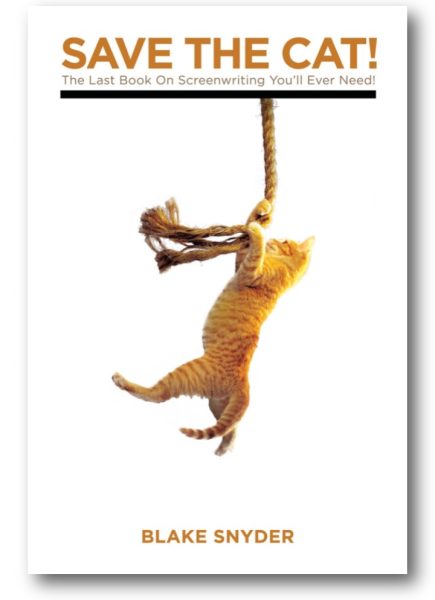
Storytellers accomplish this by creating scenes in which the main character does something that is universally recognizable as likeable or even heroic. The legendary screenwriter Paddy Chayevsky dubbed these “pet the dog” scenes. (Or for you cat lovers, check out Blake Snyder’s book, Save the Cat.) The possibilities are endless, but whatever you choose, make sure you show the main character exemplifying a strength, a value or some behavior that will generate an emotional connection to the audience.

What: What is happening? Why are we seeing this person on this day? What is the situation they are in? Let’s start to get an idea about what they want – so the audience can wonder what will happen next (which is the secret to them continuing to pay attention). A great way to get right to the what is by starting in the middle of the action.

As Deneen L. Brown writes later in her essay, “I often begin with the tensest moment I’ve encountered in my reporting. I start the story on a pinpoint but then spread out.” So, rather than starting from neutral territory (where everyone is calm and happy) and then waiting for something big to happen, start when the big thing has just happened. Then your audience is piecing together the who and where of the story as they breathlessly follow the action.

To test whether this works for your story, lay out the sequence of events and identify the moment of highest tension. Then dive right into describing that moment for your protagonist. You might find that the middle of the action is the perfect place to begin.

Where: Nothing fancy here. Where are we? The audience won’t be able to connect to the story until you can set them in a specific time and place. A few well-chosen details can create a world to welcome your reader to. You want the audience to be able to picture themselves in the room with your character(s) and decide to stick around.

In a recent Goodman Center storytelling webinar, one of our students, Josh Taylor from Wordplay Connects wrote a compelling story to illustrate how his organization can turn young people in the Potomac Highlands region into lifelong readers. Taylor started his story this way:

Dexter crosses the threshold of the bookstore, the jingle of its doorbells rattling behind him. As his mother greets the owners cheerily and tugs on his reluctant arm, Dexter warily sizes up the rows of bookshelves which tower over him. He idly stands by as the adults discuss their goings-on, then his face flushes bright red as he realizes they’re talking about him.

In just three sentences, we know who the story is about, where we are, what is happening… and we’re left with that important sensation of wondering why people are talking about Dexter.

In improv, we practice creating the who, what and where in three lines – or less! This is a great exercise for both getting unstuck but also starting your story in a way sure to grab the audience’s attention. Because as Lisa Cron reminds us in her book, Wired for Story, “From the very first sentence, the reader must want to know what happens next.”

ICYMI: What Stories Can Learn from Jokes

This article is from the December 2012 edition of our newsletter “Free-Range Thinking.” 

The next time somebody says, “Three guys go into a bar,” pay attention. There’s a lesson in storytelling behind the laugh.

Barnet Kellman

The next time somebody says, “Three guys go into a bar,” pay attention. There’s a lesson in storytelling behind the laugh. Barnet Kellman is an Emmy Award winning director best known for helming over 70 episodes of the hit series “Murphy Brown.” He currently teaches a course entitled “Foundations of Comedy” at USC’s School of Cinematic Arts, but it was back in 2008, when he was teaching a class on directing that he hit upon an offbeat way to teach his students the fundamentals of storytelling. He made them tell jokes.

“I gave them an assignment before the first class,” Kellman told me when we spoke by phone last week. “They had to bring a joke and be prepared to tell it.” There was one condition: it couldn’t be a knock-knock joke or a riddle. The students did their homework, the jokes told in class ran the gamut from hilarious to weird to just plain dumb, and by the end of the exercise, Kellman had made his point.

“Making them tell jokes gave them an obligation,” Kellman said, putting extra emphasis on the last word. “They had to keep people’s interest and get a laugh at the end.” In fact, Kellman asserts that joke-tellers have no fewer than five obligations to their audience if they are going to earn a good laugh. As Kellman outlined these obligations, I could easily see the parallels to telling a good story:

1. Quickly grab attention. Jokes, stories, newscasts, commercials – all forms of communication have this initial obligation because we live in an age of ADD. Kellman said that good joke-tellers instinctively start with the same word – “So…” – because it’s the fastest way to meet this first obligation. “Anything else is warming yourself up and wasting time,” he added. “You can’t wander. You’ll lose your audience.”

2. Create interest through incident and/or identification with character. A joke, like a story, is an invitation to temporarily leave the real world behind and teleport instantly to another time and place. Most people are happy to take this leap, but they need a little help first. They need characters with whom they can identify or a familiar scene they can enter. When a joke-teller says, “Three guys go into a bar…” he’s meeting this second obligation with just six words. As an illustration for his directing class, Kellman used a joke that begins with precisely this set-up. Before you go any further, go to this jokes page and scroll about two-thirds down the page to read the full text.

3. Build tension through complication, elaboration and misdirection. Laughter is literally the body’s way of releasing tension, so it stands to reason that the more tension a joke-teller can build up, the bigger the laugh. Note how the joke about the three men in a bar presents a pattern of behavior (i.e., tossing bottles in the air and shooting them) that builds into a bizarre battle of one-upmanship. Stories build tension in similar ways, giving the audience just enough information so they understand what’s happening but are curious to see what happens next.

Photo courtesy of callmefred.com

4. Make “the turn” (i.e., a sudden change in attention or subject). “A joke is really two stories,” said Kellman in explaining the fourth obligation. “The set-up gets us following one story, but we ultimately end up in another.” The bottle-shooting contest seems to be a story about a macho display of hometown pride until the third man (from Boulder) shoots the other two. The stories you tell may never feature such a dramatic turn of events, but they do require some element of surprise. “You keep people interested by not letting them know exactly where you’re going,” said Kellman.

5. Deliver the punchline. Like stories, jokes are intended to convey meaning, and that’s what the punchline is all about. After all the elaboration, complication and misdirection, the punchline reveals the true meaning of the story: the Boulderite in the bar isn’t a cold-blooded murderer. He’s just an ardent believer in recycling! “The laugh at the end proves you’ve successfully conveyed your meaning,” said Kellman. “It’s a verdict you can’t hide from.” Storytellers don’t have to deliver punchlines, but their tales must convey meaning – the final, and perhaps most important obligation of all.

After 24 Years Helping Good Causes Tell Better Stories, Andy’s 5 Parting Requests

When I began this work in 1998, gas was $1.07 per gallon. The world’s most popular mobile phone was made by Nokia. The Bill & Melinda Gates Foundation did not exist. Also absent from the public interest sector was significant interest in the craft of storytelling. Whenever I would talk to prospective clients about improving their narrative skills, reactions ranged from disinterest to mild disdain. Get serious, many told me. One doesn’t change the world with a bunch of anecdotes.

Twenty-four years later, I can report that attitudes have changed dramatically. It’s hard to find a public interest organization today that isn’t telling stories or talking about ways to “change the narrative.” That said, I cannot report that all the stories I’m seeing are well-told or are the best kinds of stories to tell. Even more troubling are the stories told in ways that do more harm than good. So, for this month’s edition of free-range thinking – the last I’ll author – I have five requests for those who still aspire to tell truly world-changing stories.   
First, be clear on the kinds of stories you’re telling and what you expect them to accomplish. In the public interest sector, most stories tend to fall into one of two categories: journalistic stories or dramatic narrative.

Journalistic stories are designed to provide everything the audience needs to know within the first few paragraphs, answering the essential who, what, when, where, why and how questions that define “news.” The remaining paragraphs fill in the story’s details in descending order of importance. The overarching purpose of this format is to inform quickly and concisely, and there is a built-in understanding that the audience does not have to stay for the entire story to glean the main points.

Dramatic narrative, in contrast, is designed to engage the audience emotionally, which can motivate them to take a specific action. These stories tend to focus on an individual or small group with whom the audience can closely identify. The narrative usually follows the three-act structure (or what is commonly referred to as a beginning, middle and end), and the audience must follow the entire story to learn what happens and, most importantly, understand why this journey was worth their time and attention.

One of the most common problems I’ve observed over the years occurs when organizations confuse the kind of story they’re telling with the intended outcome. Simply put: If your goal is to spread awareness, the journalistic model is fine. But if you want your audience to actually do something – to sign, to march, to give – then you need dramatic narrative. Emotions are the precursors to actions, and journalistic storytelling simply isn’t designed to provoke emotional engagement.

Second, it’s time to move beyond the “broken person model” of storytelling. Also known as “deficit-based” framing, these stories introduce us to an individual at a crisis point (if not the lowest point) in their life. They are unhoused, unemployed, food insecure, a victim of domestic violence, addicted to drugs, or any combination of such dire circumstances. Through some means (often unspecified, which is another problem), they come into contact with our organization, and thanks to a specific program or initiative, they emerge a “fixed” person with a better life trajectory. (You can read more about problems caused by deficit framing in our March 2022 blog post.)

This storytelling model can evoke pity, but what you really want is empathy. Writing in Psychology Today in 2015, Dr. Neel Burton explained the key difference between pity and empathy: “Pity is a feeling of discomfort at the distress of one or more sentient beings and often has paternalistic or condescending overtones. Implicit in the notion of pity is that its object does not deserve its plight, and, moreover, is unable to prevent, reverse, or overturn it. Pity is less engaged than empathy, sympathy, or compassion, amounting to little more than a conscious acknowledgment of the plight of its object.”

The antidote to this common problem is, as you might guess, asset-based framing. Trabian Shorters, a thought-leader on this form of storytelling, calls it “a narrative model that defines people by their assets and aspirations before noting the challenges and deficits.” Or as we like to say at The Goodman Center, let your audience meet a person before they see a label. (Read more on asset-based framing in our March 2022 and May 2022 blog posts.)

Third, please stop calling everything a story. I cannot count the number of websites I’ve visited that present client testimonials but label them stories. There is no denying that testimonials have value – putting a human face on your proof of concept is always better than numbers alone. But a quote from a client thanking the organization for turning their life around rarely has the same impact as a full-fledged story in which we can see (and feel) for ourselves how that life was transformed. (The same can be said of most case studies, organizational histories, and donor profiles, which all have the potential to be powerful stories but are usually presented without the key elements.)

Fourth, even elite athletes have coaches and trainers, so…. If you want to enhance your storytelling skills and avoid the problems noted above, don’t be reluctant to ask for help, and I hope your first call will always be to The Goodman Center.

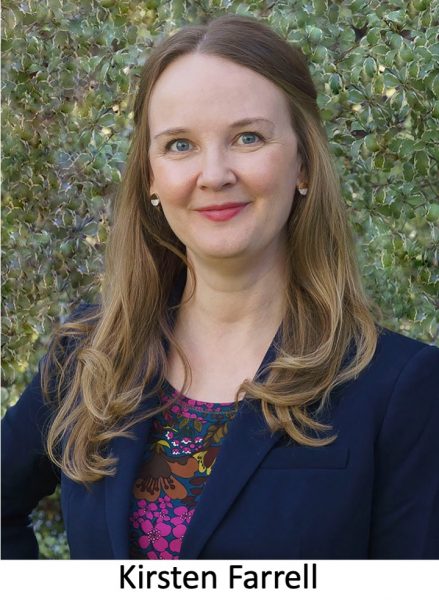
Our new Director, Kirsten Farrell, has storytelling in her DNA. As a member of the nationally recognized Impro Theatre, she is part of a company that crafts long-form improvisational plays, literally creating 90-minute stories on the fly in front of live audiences. You simply cannot do that unless you know the rules of storytelling inside and out (and also know how those rules can be bent or even occasionally broken and still delight an audience.)

As an advisory team member for The Corporation for Supportive Housing’s “Speak Up! Program LA,” Kirsten trains people with lived experience of homelessness to tell their stories. And since joining The Goodman Center in 2021, she has facilitated dozens of in-person and online workshops helping public interest organizations across the U.S. and around the globe hone their storytelling skills. I am honored and thrilled that she will be continuing the work I started back when I was filling up my car’s tank for $10 and making calls on my very cool Nokia flip-phone.

Fifth and last, never lose faith in the power of your stories. They are, always have been, and always will be the essential currency of human communication. Which is why I will end my last newsletter with the same words we use to end every storytelling class we offer:

Numbers numb, jargon jars, and nobody ever marched on Washington because of a pie chart. Stories, by their very nature, tend to get stored in our brains. So, if you can change the story inside someone’s head, you’ve taken the first step to changing the world.