Asset-Framing Case Study: How SEARAC Got it Right

In last month’s edition of free-range thinking, we featured an article entitled “Why Asset-Framing is Better Storytelling,”  and we were thrilled to hear from many readers who expressed interest in applying this approach in their communications.
This month, in response to such enthusiastic feedback, we’re spotlighting an exemplary use of asset-framing by the Southeast Asia Resource Action Center (SEARAC), a national civil rights organization whose mission is to “[empower] Cambodian, Laotian, and Vietnamese American communities to create a socially just and equitable society.”

SEARAC recently created a series of public service announcements to mark the 25th anniversary of the Illegal Immigration Reform and Immigrant Responsibility Act. The final drafts of these PSAs are excellent examples of asset-framing, but earlier drafts were falling into the familiar trap of deficit-framing. Fortunately for our readers, SEARAC generously offered to share both versions with us, because when viewed side-by-side, they provide a helpful case study for any good cause looking to apply asset frames of their own.

Elaine Sanchez Wilson, Director of Communications and Development for SEARAC, recently participated in one of our four-week storytelling classes, which contains a unit on ethical storytelling. After we presented background on Trabian Shorters and asset-framing, Elaine told us she had already been learning about this approach, and she wanted to share with us a project they were working on at SEARAC.

That project was the PSAs for the anniversary of the 1996 immigration act. Each PSA featured a story of a Southeast Asian American refugee who have served time for a decades-old conviction, and who was personally affected by deportation.

In the first draft profiles of these brave individuals, however, Elaine and her team hadn’t yet applied the principles of asset-framing. The descriptions they wrote leaned on deficit frames that remain all too common throughout the public interest sector. Here are two examples: (Please note: to protect privacy, we have replaced real names with pseudonyms and changed certain facts. While these are not actual profiles, they are accurate representations of the early drafts SEARAC had developed.)

Kiry Chan, a Cambodian refugee, experienced the trauma of the Killing Fields. He survived only to face the threat of deportation after serving 18 years in prison. Now, he has turned his life around to become a loving father and revered community member. Nevertheless, the threat of deportation is a constant in his life.

Minh Do, a Vietnamese refugee who endured gang violence and poverty growing up, served a long sentence in prison. He has since transformed his life, dedicating himself to serving his community. He is hoping to make things better by sharing his story. But despite the new life he has created for himself, ICE may deport him at any moment.

As you can see, the first thing you learn about each individual is that they are a “refugee,” which is a label that makes them more of a thing than a person. We learn they have “survived deportation” and “endured gang violence” before getting to anything positive, which is more likely to prompt pity as opposed to empathy.

After learning more about asset-framing, Elaine and her colleagues at SEARAC took another look at these profiles. They realized that how they introduce people can either reinforce stigmas or help to break them down, so they knew what they needed to do. Here are the new descriptions they wrote:


Ge Vang
is a leader in the Hmong culture Vang clan. He is a father of four kids, including Damu who joins him in his PSAs. He recently won post-conviction relief, but, as a Hmong refugee, he still faces the threat of deportation. He wants people in similar circumstances to understand that they are not alone and that there are communities that want to help.

 

Nghiep (Ke) Lam is a member of a resilient and kind community of formerly incarcerated individuals, artists, queer leaders, and members of community organizations. He has been honored by every level of the US government (city, county, state, and federal) for his work. A refugee from Vietnam whose family survived the South China Sea and Hong Kong refugee camps to make it to America, Nghiep is doing this project in order to help give voice to the thousands of people fighting for their freedom to be accepted as citizens. Yet he can be deported at any moment to a place he barely knows.

Leader. Father. Resilient. Kind. Consider how these words build a frame for the reader as opposed to refugee, survivor, trauma and poverty. Instead of meeting labels, we are meeting Ge and Nghiep as people with aspirations and contributions.

Today, Elaine and her team at SEARAC are changing the narrative about deportation not only by sharing stories, but also through the way they are sharing stories. We hope these examples they have generously shared will help you do the same.

Why Asset-Framing is Better Storytelling

Somber music plays behind hard-to-watch pictures of starving children. The voiceover begins: “The need is painfully evident in their eyes, in their tiny bodies that weigh no more than young babies. In their desperate struggle to find any means to survive, and in their loss of hope that help will ever arrive in time. Sixteen million people are on the brink of starvation here in East Africa, and hunger takes its toll in many brutal ways.”

This is a verbatim excerpt from a PSA intended to raise money to end hunger, and if the script sounds familiar, that’s because it’s a recipe that has been used for decades. Start with a problem; add some music, sad pictures, and a sad tale; ask for money. The formula can work, but take a step back and you’ll see a bigger problem. It’s called “deficit framing.”

In stories told with deficit framing, the people we meet are already in a distressed or perilous state. They are starving, homeless, addicted to drugs, or a victim of abuse. Stories told this way may evoke emotion, but that tends to be pity instead of empathy. The people who are experiencing hardship appear as objects at the mercy of events and without agency to change things. This also strengthens a savior-style narrative that positions the organization as the only thing (along with your dollars, of course) that can fix these broken people.

Fortunately, this ethical trap in storytelling can be avoided through a practice called “asset-framing.” Trabian Shorters, a leading expert and advocate for asset-framing, calls it “a narrative model that defines people by their assets and aspirations before noting the challenges and deficits.” This means your story introduces the protagonist (i.e., who the story is about) as a person with accomplishments, hopes and values before we get to the challenges that ultimately led them to your organization.
Consider the following transcript from a video posted on the website of Pathfinders, a nonprofit that offers services to people who experience homelessness. The guest speaker, Yolanda Seely, talks about her journey into and out of homelessness, but before she gets to any of that, she will tell you a few things about herself:

“My name is Yolanda Sealy. I was born and raised in Rantoul, Illinois. I’ve always been a hard worker, and in high school I was a triathlete. I played basketball, volleyball and I ran track, and I was an honor student. My talents earned me a Division One scholarship. I played basketball at the University of Illinois, Champaign-Urbana. When I graduated from the University of Illinois, I moved to Houston, TX and shortly after I joined the United States Army. I served eight years in the army active duty and two years Army Reserve. I’m a mother of two beautiful girls: Ariana, my daughter who’s 14 and Ariel, who’s three years old. And those are the joys of my life.”

Asset-framing is not only a more ethical way to tell stories – it’s fundamentally sound story structure.

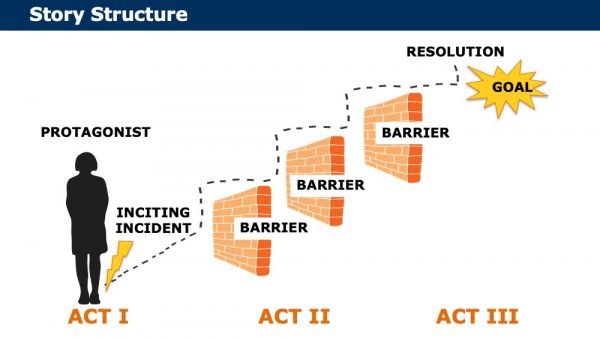
Act 1: We introduce the audience to a protagonist – someone they can care about and root for through the rest of the story. In the Pathfinders example, that’s Yolanda: a loving mom, a college graduate, and a veteran. Then comes the inciting incident, the event that kicks the story into motion and gives the protagonist a goal: Yolanda loses her job. Now she must find a way to keep food on the table for her children.
Act 2:Our protagonist encounters barriers: hardships, struggles and brick walls. Yolanda loses her apartment, and without someplace to live, it is nearly impossible to find a job. Yolanda is not one to give up, however, and working with Pathfinders she finds ways to surmount these barriers.

Act 3: This is where the story resolves and the meaning becomes clear. Yolanda has a home again and has recovered the self-sufficiency she valued about herself. She’s changed and she’s learned a lot, and we have some new insights into exactly how Pathfinders works with the people it serves.

If you tell stories with deficit-framing, you are starting with the barriers. Go back to that PSA about starving children in East Africa at the beginning of this article. It skips Act I and goes straight to the barriers of Act II! To a certain extent, this mistake is understandable. When organizations tell stories about people they have served, they start from the moment they met them. But that isn’t the beginning of their story.

Every person has a whole story before they meet us. They have aspirations and accomplishments, they have values, things and people they love. That’s how we should get to know them. Before the inciting incident. Before the barriers. Because you want the audience to see themselves in this person. Because you want them to feel compelled to act. Because you are striving to create empathy, not pity.

And because it’s also better storytelling.

How Stories Make Two Hearts Beat As One (Literally)

As Valentine’s Day approaches and thoughts turn once again to love and romance (and that dinner reservation you forgot to make, so get on it already!), we would like you to remember that a” heartfelt story” is more than just an expression.

Chelsea scooches her chair closer to the small, candlelit table for two and takes in her date’s uneven dimples. He’s cute. Almost cute enough to forget the pain of her going-out boots which are cutting off circulation to her toes. Her mind is racing, “Are we going to have anything to talk about?” A few exchanged niceties about the restaurant don’t do much to ease the awkward tension. But then Dimple Guy says something that gets Chelsea’s full attention: “I was almost late because I’m watching the last season of Ozark and I could barely turn it off.”

Chelsea sits up excitedly, suddenly forgetting this is a first date. “I love that show!” she exclaims, maybe a little too forcefully. And they are off to the races, sharing favorite parts and theories about what’s coming next. Jordan (the date formerly known as Dimple Guy) doesn’t feel like a stranger anymore to Chelsea. They are both really into this show, and it’s starting to feel like, maybe, just maybe, they could be into each other, too.

So, what does this meet-cute have to do with you? A study authored by Lucas Parra, a professor of biomedical engineering at City College of New York, helps to explain the connection made in moments like these. “Conscious processing of narrative stimuli synchronizes heart rate between individuals,” Parra writes. Or as Susan Pinker writes in an article for the Wall Street Journal: “Research shows that listening to the same narrative leads our heart rates to rise and fall in unison.” First date or not: when we read, watch or listen to the same story as someone else, whether they are in the same room with us or not, we sync up. We share the experience in a visceral way.

Between theories about the brain’s mirror neurons and now Parra’s study of the heart, scientists are proving again and again that stories connect us with one another. You have probably experienced this synchronizing effect yourself. Each time you discovered a shared story with a colleague, client, legislator or donor, you probably got the feeling that you really shared something. And that’s because you did. Your hearts, the actual organs themselves, took the same journey. You really were in it together.

So, when you need to create a spark between your audience and your organization, why not sync their heartbeats with each other’s and with yours? Connect, create common ground, advocate, and make your audience fall in love with your cause by using the most powerful tool there is: a good story.

And Happy Valentine’s Day from all of us at The Goodman Center!

100+ Tips for More Visually Engaging Presentations

If you’re completely satisfied with your PowerPoint, Keynote or Google Slide presentations and believe they couldn’t look any better, please skip to the next article. For the remaining 99% of us, however, there are two new resources which are chock full of tips for sprucing up your decks:

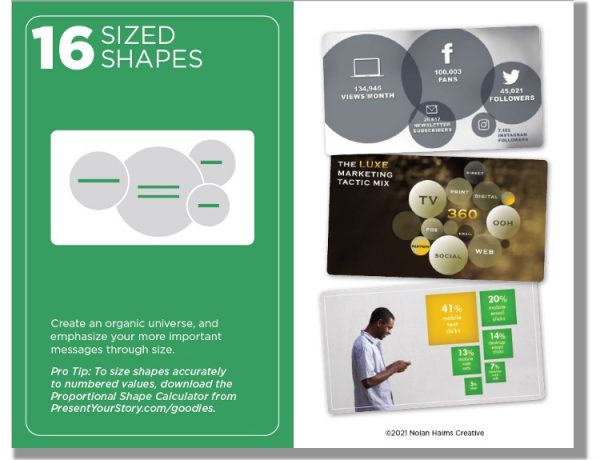
The Better Deck Deck: 52 Alternatives to Bullet Points is a clever bundle of good ideas from Nolan Haims, a guru of presentation design and co-host of The Presentation Podcast. As the deliberately redundant title suggests, the ideas are presented in a deck of 52 cards, and each card presents not only a design idea but also three examples of its execution of the reverse side. The entire deck is divided into four sections for design ideas with text, shapes, images and diagrams. You can order the cards, a PDF version, or the PowerPoint source file with the actual slide examples here.
 

Everything I Know about Life I Learned from PowerPoint is Russell Davies’ latest book, and it also offers more than 50 tips for improving the structure and design of your presentations. Davies knows a thing or two about designing eye-catching, mind-opening presentations, having designed for Nike, Microsoft and Apple, written about it for Wired magazine, and even having delivered presentations at 10 Downing Street in London. Rest assured that if you work with Keynote, Google Slides or Prezi, Davies has practical and usable tips for you, too, despite the book’s title; and I can assure you it’s a fast, funny, and highly worthwhile read. Find out more about the book and order your copy here.
New Year, New Lies – How to Fight Back

Here’s one prediction for 2022 that I can make with confidence but no joy: your social media feeds will continue to be polluted by misinformation, propaganda posing as fact, and bald-faced lies. No matter how much Facebook, Twitter and other platforms promise to crack down on bad actors, tweaking algorithms and banning the Marjorie Taylor Greenes of the world will be little more than fingers in a rapidly crumbling dike.

If we want things to change, we have to follow Gandhi’s advice and “be the change we want to see in the world.” That process begins by educating ourselves on the causes and scope of the problems we face, and then developing tools to fight back – to expose false narratives and replace them with more compelling stories based in truth, backed by science, grounded in reality.

To help you get started, we offer three books, three websites, and an additional reading list as curriculum for your very own “Fighting Misinformation 101” course. Registration is free and the cost of skipping this class is high, so dig in. There will be a test.

There is no shortage of excellent books about this age of Too Much Misinformation, so please consider the recommendations that follow only as a starting point:

The Demon-Haunted World: Science as a Candle in the Dark, by Carl Sagan & Ann Druyan (Random House © 1995)

To begin to understand why human beings are so vulnerable to myths, conspiracy theories, and outright lies, start here. Published in 1995 – well before smart phones, social media and Fox News even existed – The Demon Haunted World is a passionate defense of science in general and the scientific method in particular. Covering a wide swath of history from 17th century witch trials all the way to (then) contemporary claims of alien abductions, Sagan and Druyan make the case that accepting fact-free explanations and ignoring contradictory scientific evidence is not new behavior. Smash cut to America 2022, a nation awash in Big Liars, global warming deniers, and anti-vaxxers, and you’ll find that Sagan & Druyan’s book feels even more relevant 27 years after its original publication.

True Enough: Learning to Live in a Post-Fact Society, by Farhad Manjoo (John Wiley & Sons © 2008)

Stephen Colbert mined the concept of “truthiness” – the idea that if something feels true, that’s good enough – for satire, but Farhad Manjoo is more interested in how it has dangerously impacted politics, business, and culture in general. Manjoo builds on the arguments begun by Sagan and Druyan in The Demon-Haunted World and brings them into the 2000s by focusing on 9/11 conspiracy theories and the 2004 “swift-boating” of John Kerry. He maintains that human proclivities towards selective perception and confirmation bias, compounded by social media feeding us only the facts we want to see, have effectively divided Americans into more than just separate ideological camps. We are actually living in separate realities.

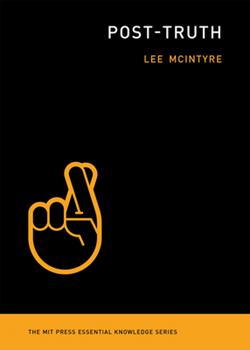
Post-Truth, by Lee McIntyre (MIT Press © 2018)

Lee McIntyre, a Research Fellow at the Center for Philosophy and History of Science at Boston University, covers similar territory to True Enough, but he adds an interesting philosophical analysis that deepens our understanding of how we got here. In Chapter 6, “Did Postmodernism Lead to Post-Truth?”, McIntyre defines postmodernism this way: “The first thesis of postmodernism [is that] there is no objective truth. Any profession of truth is nothing more than a reflection of the political ideology of the person who is making it.” With this definition in hand, McIntyre draws a straight line from postmodern philosophers such as Jacques Derrida and Michel Foucault to modern day pathological liars such as Donald Trump and Kellyanne Conway and ultimately concludes “postmodernism is the godfather of post-truth.”

And if you want to check out additional titles in this growing field of literature, take a look at “Ten Good Books About Bad Information.

We also recommend visiting the following websites to find tools for battling misinformation and, happily, some comic relief as well.

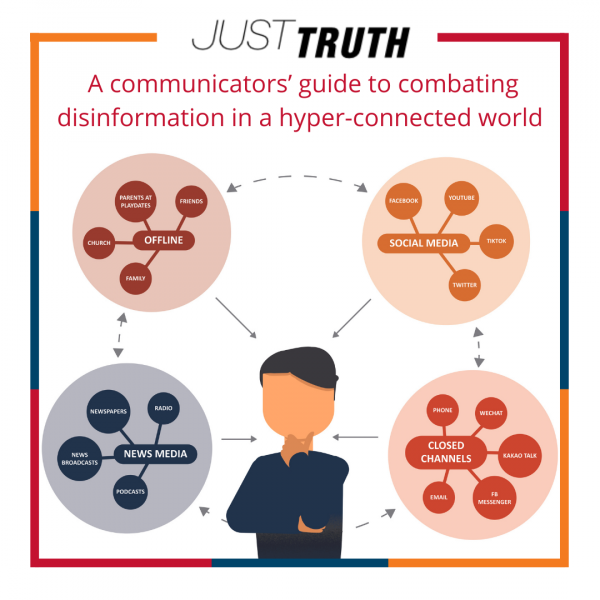
Just Truth: A communicator’s guide to combating disinformation in a hyper-connected world.

Whether to preserve corporate interests, hoard political power, or maintain white supremacist and patriarchal systems, false narratives have been disseminated for decades (or even longer) in the U.S., and it’s only getting worse as we enter 2022. Convinced that fighting disinformation is a teachable skill that public interest organizations need to develop, Spitfire Strategies recently launched “Just Truth.” Through this free online guide, Spitfire is collecting and sharing existing research on disinformation techniques and campaigns to help progressive nonprofits battle them more effectively in their communication efforts.

Bad News

While fake news is a serious problem, teaching people how to recognize it doesn’t have to quite so serious – or so says Jon Roozenbeek, co-creator of the online game “Bad News.” The conceit of this game is that it teaches players how to be a purveyor of fake news. As you play, you earn badges for developing six sinister skills: impersonating other tweeters (especially anyone more famous or credible than you), touting conspiracy theories, antagonizing highly polarized groups, discrediting sources (particularly anyone who dares to criticizes you), trolling, and using emotional content. The real purpose of the game, however, is not to educate a new legion of online scammers, but instead to, as Roozenbeek puts it, “create what you might call a general ‘vaccine’ against fake news, rather than trying to counter each specific conspiracy or falsehood.” Does this particular “vaccine” work? Play the game and see for yourself!

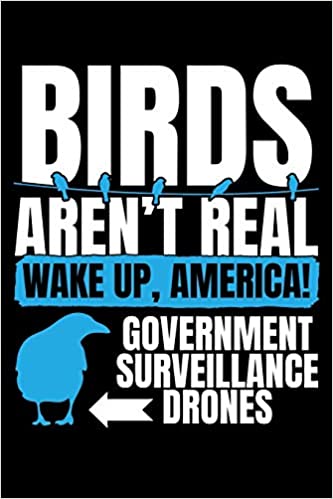
Birds Aren’t Real

While Jon Roozenbeek is battling the onslaught of fake news with a game, Peter McIndoe is going one step further. The 23-year-old from Memphis is trying to beat the fakers at their own game by spreading the most outrageous lie he can think of: birds aren’t real. They are drones built by the government to spy on us and carry out other nefarious tasks. The avian awareness campaign which McIndoe began as a lark (sorry, couldn’t resist) in 2017, has developed a life of its own, spawning chapters across the country, spreading its message on billboards and t-shirts, and generating tons of free media coverage. “It’s a safe space for people to come together and process the conspiracy takeover of America,” McIndoe told The New York Times last December. “It’s a way to laugh at the madness rather than be overcome by it.”

A Good Time to Talk About Endings (and How to Make Yours Better)

Imagine attending a dinner party that begins with scrumptious hors d’oeuvres and drinks, proceeds to a delicious meal with lively conversation, concludes with a decadent, mouth-watering dessert, and then the host suddenly exclaims, “Sorry, we’ve run out of time!” and hustles everyone out the door in thirty seconds. A perfect evening has just been ruined by an abrupt ending, and as you hastily depart, you’re probably thinking, “We’re never going there again.”

This unspeakably rude scenario has an all-too-common analog in the public interest sector. More often than I can count, I have attended presentations and webinars which got off to a promising start, delivered solid content, but dropped the closing curtain with the speed (and equally disconnecting effect) of a guillotine blade. Now, I don’t wish to imply that a mangled ending automatically invalidates everything that came before, but your closing is a critically important part of the entire experience.

In short: endings matter, especially when your objective is to inform, educate, or motivate. So, as we head into December and bring another year to a close, what better time than now to focus on the best ways to end a presentation, webinar or just about any gathering of humans be it face-to-face or screen-to-screen.

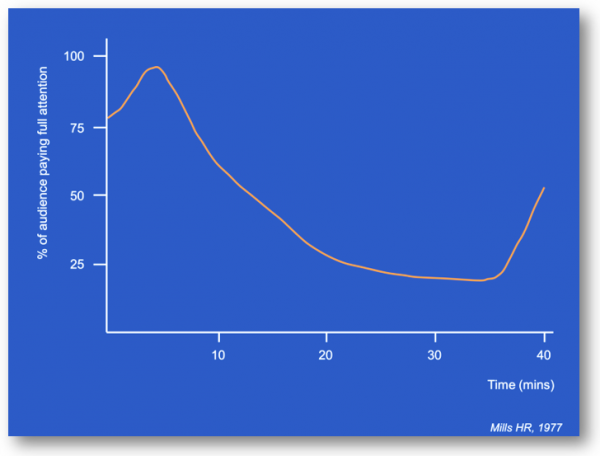
In his book, Teaching & Training: A Handbook for Instructors (Macmillan, 1977), H.R. Mills presents a graphic rendering of students’ attention spans in the classroom (see illustration). “Interest starts off high,” Mills writes, “though no matter how good an instructor may be, he will rarely have the full attention of all the class. Interest drops. Fatigue and boredom set in and persist until banished by the pleasant anticipation of the end of the period” (italics mine.)
Based on my 20+ years of experience giving presentations, leading webinars and also being an audience member, I’m convinced the same pattern exists among our colleagues in the public interest sector. It’s just human nature. When a session begins, we are curious about the speaker(s) and the subject and usually hopeful that the hour (or more) will be time well spent. And when we hear the words, “In conclusion…” even those among us in the deepest reaches of REM sleep will arouse and listen more closely for those words of wisdom that make it all worthwhile.

Most presenters and webinar leaders recognize the importance of a strong opening, but it’s still surprising how many pay scant attention to the ending. “Well, I see we’ve run out of time,” they’ll say before issuing a few perfunctory thank-yous and abruptly ending the session. Given the spike in attention that’s just been handed to them, this is a wasted opportunity. Consequently, I always recommend leaving enough time for a three-step closing:

Step 1: Summarize

There’s a maxim in public speaking that goes so far back I cannot find agreement on the original source: “Tell ‘em what you’re going to tell ‘em; tell ‘em; tell ‘em what you told ‘em.” Step 1 of a good closing is that last piece — simply spending a few minutes recapping the major points that were made during the presentation or webinar.

Step 2: Take Questions

Even if you’ve taken questions earlier in the session, it’s always advisable to have one final Q&A segment to address any lingering concerns. But above all, do not end your presentation with Q&A. Questions may stray from your topic, be relevant for the questioner but not the larger audience, or may not be questions at all – just an opportunity for someone to hold forth and hijack your session. Even if all the questions are on point (which I wouldn’t put money on), letting someone else have the last word is a risky proposition, especially when the audience is paying attention again. Which bring us to the third and most important step in your closing…

Step 3: Stick the Landing

The final minute or two is your opportunity to tell one more story, restate your message as concisely and eloquently as possible, or provide an inspiring vision. Above all, this is your moment to express in no uncertain terms what you hope the audience will do with the information they have just received or the skills just acquired. (If you are moderating a panel discussion, you can give each panelist a prescribed amount of time for a closing statement along these lines.) When you Stick the Landing, you make sure that the last thing ringing in the audience’s ears is the one thing you want them to remember.

Gosh, looks like we’ve run out of space. See you next month! (JK)

The #1 Tool for the #1 Mistake in Communications Planning

As you look down the road of communications planning, take heed: there’s a huge pothole ahead that can swallow your entire campaign. In more than two decades working with public interest organizations, I’ve seen far too many drive straight into this chasm before they even could apply the brakes. It’s called “the leap to tactics,” and see if you recognize the warning signs.

Your CEO says, “We need a video on TikTok!” Or a legislative director declares, “We need to hold a press conference!” Before anybody has asked questions such as, “What is our objective here?” or “Who can make this happen?” the discussion has already turned to tactics. And while this may feel proactive and invigorating, too often it leads to a waste of time and money.

Fortunately, there’s a free tool that can help public interest organizations avoid this pothole and put strategy considerations ahead of tactics where they rightfully belong. First developed by Spitfire Strategies in 2002, the Smart Chart has just been updated to version 4.0, and nearly twenty years after its debut, it remains the most effective tool for avoiding the most common mistake in communications planning.

The first iteration of the Smart Chart was created In 2002 when the David and Lucile Packard Foundation challenged Spitfire to write the definitive how-to guide for communications planning. After interviewing nearly 100 communications experts, Spitfire developed an online planning tool with enough built-in flexibility to work for both a wide range of issues as well as for organizations of all shapes and sizes.

As Spitfire collaborated with clients over the years and studied emerging social science, they continued to update the tool, unveiling versions 2.0 and 3.0. The Smart Chart was widely used by numerous social change campaigns both across the U.S. and around the globe, and it has been translated into multiple languages including Spanish, French, Urdu and Tagalog.

When the COVID-19 pandemic further exposed systemic inequities disproportionately impacting Black and Brown people, Spitfire overhauled the Smart Chart once again. Version 4.0, which was officially released in September, highlights equity and racial justice, evolves the thinking about framing, integrates even more brain science research, and features an improved online planning interface.

So the next time someone on your team says, “What we need right now is [insert tactic here]!” help them steer around that impending abyss and give the Smart Chart 4.0 a try. The time and money you save may be your own.

How 9/11 Reminds Us of the Awesome (but Volatile) Power of Living in the Same Story

Where were you that day?

I was in Los Angeles, three thousand miles away and three hours behind, but the distance in space and time collapsed that morning. After our son and daughter had already left for their respective schools, my wife and I got word that something inexplicable was happening in New York City. By the time we turned on our TV, both towers of the World Trade Center were billowing smoke, the Pentagon had been hit as well, and it was clear this was a coordinated attack unlike any other. Just before 7:00 AM our time, the South Tower collapsed right before our eyes. About a half hour later, the North Tower went down. And then the rumors started.

There were still hundreds of planes in the air. Any plane might be turned into a missile. Nobody was safe, even thousands of miles away from the devastation on the East Coast. Despite assurances from their schools that our children were safest where they were, we hustled them home as fast as we could. And then, like millions of others, we spent the rest of the day frozen in front of the television, horrified but unable to look away, and struggling to understand what was happening.

In the ensuing days and weeks, I noticed a change in my interactions with strangers whom I passed on the street or stood behind in line at the supermarket. We would catch eyes momentarily, and without speaking a word, an understanding passed between us. We had all seen it. We had all felt (and were still feeling) the shock of it. Even the mundane act of waiting in a crowd for an elevator was suddenly charged with emotion. You just knew what everyone was thinking: What about those people who waited for an elevator that never came? What about the loved ones they left behind? But along with the horror and sadness, we were feeling something else, and perhaps you felt it, too: a sense of connection borne of shared trauma. We were all in the same story.

Extraordinary things can happen when millions of people feel connected by a single narrative. They can march for justice. They can also march into war, which was the direction that the Bush Administration chose to lead us in the aftermath of 9/11. Stories are neither inherently good nor evil, but I would submit that they remain unparalleled when it comes to bringing people together and moving them towards action. Human beings have literally evolved as a species that relies on stories to understand how the world works, how to survive, and how to thrive. When we all agree on the same stories, we pull together and form tribes, religions, and nations.

And yet, these rare, all-encompassing stories can also be volatile, quickly mutating and dividing into conflicting stories that tear us apart. Certainly, this is one of the major lessons of the coronavirus pandemic. Think back to March 2020 when reports of the virus started to accelerate until suddenly every aspect of daily life came to a crashing halt. I remember standing in line outside my local supermarket waiting to buy toilet paper, again catching eyes with strangers, but this time because it was the only part of their face that wasn’t covered by a mask. Once again, we were able to communicate without words because we were all in the same story. But not for long.

Within a few months (if not weeks), the simple act of wearing a mask divided into two stories. One was about protecting your health and the health of people around you. And the other was about succumbing to government interference and yielding personal freedoms. Once again, we witnessed how powerfully stories can unite groups of humans, but tragically in this case, into warring tribes within one nation.

So, on this 20th anniversary of 9/11, as we all remember how we felt and consider what we’ve learned, I hope you’ll also take a moment to consider the unequaled potential of stories to unite your audience, advance your mission, and make the world a better place. Your work is too important to use anything less.

Your Summer Viewing List (Part 2)

We hope you had a chance to check out the five award-winning campaigns featured in our July issue and, as promised, this month we’re introducing you to five more. Once again, they address a wide range of issues – everything from infant malnutrition to the epidemic of loneliness among older adults – and each has been recognized by the Cannes Lion Awards for outstanding creativity. Thanks again to Lovethework.com for compiling the complete list of 2020-2021 Cannes Lion award winners, and to Storythings for introducing us to Lovethework.

  MOTHER BLANKET

In the Ecuadorian Andes, over 300,000 children suffer from chronic undernourishment. Parents often believe that a chubby baby is healthy, but the child’s height is actually a more precise indicator than its weight. To address both the problem and popular misconception, Fundacion Vivir, a local NGO, produced baby blankets (known in the Andean tradition as “Sikinchi”) with a growth chart sewn into the blanket’s design. Following World Health Organization guidelines, the blankets help parents accurately track their babies’ growth and recognize abnormalities early on. Last year, the “Mother Blanket” helped identify over 15,000 cases of malnutrition that might otherwise have gone undetected.


THE PEDESTAL PROJECT

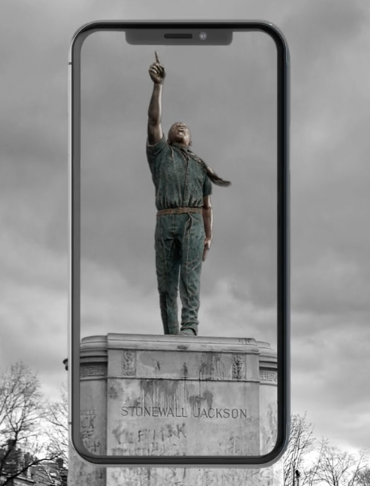
What do you do with a monument to Confederate soldiers after the statue has been torn down and only the empty pedestal remains? In February 2021, Color Of Change, the nation’s largest online racial justice organization, launched The Pedestal Project to place racial justice leaders atop those pedestals. This wasn’t a costly statue-for-statue replacement program, however. Color of Change asked people to use an augmented reality tool on their phones to place 3D images of the new statues on the pedestals (displaying leaders such as John Lewis, Chelsea Miller and Alicia Garza), take pictures of the virtual monument, and then share them on Instagram. The online campaign reached 48 countries and tallied over 600 million media impressions without Color of Change spending a single dollar to promote it.

THE PUNISHING SIGNAL

Mumbai is infamous for its traffic jams, and rightly so: frustrated drivers are known to honk during red lights even though a countdown timer indicates exactly when the light will turn green again! To address the noise pollution resulting from these jams, the Mumbai Police department implemented a creative solution: “The Punishing Signal.” Devices measuring decibel levels were connected to traffic signals throughout the city. When the cacophony from the honking horns exceeded 85 decibels, the countdown timers would automatically reset to a longer-than-usual waiting period while an electronic sign would flash the message, “Honk more, wait more.”


THE LAST OLDER PERSON TO DIE IN LONELINESS
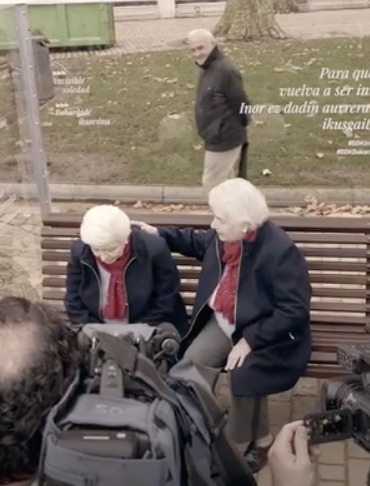
The World Health Organization has called loneliness “the epidemic of the 21st century.” The problem is particularly prevalent in Spain where over 2 million older adults live alone. Further aggravating the situation is that loneliness is often an invisible problem since older adults may be isolated in homes and apartments, out of view from the general population. To raise the visibility of this issue, the BBK Foundation designed and installed a hyper-realistic sculpture of an older woman, Mercedes, and placed it on a park bench in a busy city. The sculpture attracted the attention of passersby, then the media, and ultimately went viral via the Internet, creating 148 million social media impressions.


GIVE HER A BREAK

When Chloe Zhao won the Oscar for Best Director this year, it was both well-deserved and anomalous: in the 92 years prior, only five women were even nominated for this award.

In 2019, GiveHerABreak.org called attention to this nearly century-long discrimination against women by creating a technology that replaced commercials airing during the Oscar telecast with trailers for female-directed films. (We could fill another entire newsletter just explaining how the technology works, but the important things to know here is (1) that it actually worked, and (2) that it was entirely legal.) GiveHerABreak used Twitter and Instagram to promote the stunt, the media picked up the story, and when the Oscar telecast began, people started logging on at the rate of 75 per second! Ultimately, that added up to over 22 million impressions at no cost to GiveHerABreak.

Your Summer Viewing List (Part 1)

Long-time subscribers to this newsletter will recall that our July issue traditionally presents a “summer reading list,” but since the past year has been unlike any other, we thought it fitting to try something new this time around. So, instead of recommending books to bring to the beach (or wherever you find respite from the summer sun), we’re providing links to videos from award-winning public interest campaigns that were conducted in 2020-2021 around the world.

These campaigns addressed a wide range of issues in healthcare, the environment, racial justice, the drug trade, gender bias and more, and every one earned a Cannes Lion Award for outstanding creativity. If you’re looking for inspiration as you prepare for battles ahead, look no further than the five amazingly clever and effective campaigns listed below. And we’ll have five more for you next month in part 2 of this list.

Special thanks to Lovethework.com for curating the complete list of 2020-2021 Cannes Lion award winners, as well as to Storythings for introducing us to Lovethework. Scroll down to access the five award-winners on part 1 of our list.)

THE BREAD EXAM

In the Middle East (as well as other parts of the world), it is considered taboo for women to talk about intimate parts of their bodies. For organizations intent on disseminating information about breast cancer and techniques for self-examination, this is a formidable barrier – but not an insurmountable one for the Lebanese Breast Cancer Foundation. As Mirna Hobballah, vice-president of the foundation, explained: “Since many households bake their own bread and are interested in this subject – especially now, during the Covid 19 pandemic – we decided to use baking bread as a euphemism and talk to women about baking bread instead of talking about breasts, self-examination or cancer.” Thus, the “bread exam” was born and eventually duplicated in countries all over the globe, reaching millions of women with critically needed information and advice.

STILL SPEAKING UP

Since 2007, over 120 journalists who were investigating the drug trade in Mexico have been murdered. Journalists working in Mexico today are understandably reluctant to speak out against the murderous cartels, but last year Propuesta Civica, a human rights organization based in Mexico City, found a way to let their voices be heard while also protecting their identities. Using the artificial intelligence technology behind “deep fakes,” they brought back to “life” Javier Valdez, a prominent journalist killed in 2017. Valdez appeared “live” on national TV in Mexico to directly address the country’s president and demand justice for his journalistic colleagues. The campaign continues to this day on the #StillSpeakingUp platform using deep fake spokespersons to help expose the cartels while protecting the journalists who cover them.


ADDRESSPOLLUTION.ORG

Air pollution is one of those environmental issues that everyone will tell you they care about, but most people will do nothing about until it affects them directly. In London, the Central Office for Public Interest knew that 10,000 residents die prematurely every year due to toxic air, so they decided to make it a pocketbook issue. Working with the agency AMVBBDO, the office devised a system to link air pollution to property prices. Simply by logging on to addresspollution.org, any London resident could find an Air Quality Report for their address showing both the health and financial impacts of pollution. Properly motivated, the homeowners were then directed to actions they could take at both the local and national levels to fight pollution. The campaign led to the passage of a law requiring home sellers to disclose the pollution levels in their neighborhoods to prospective buyers.


THE CALL

“When it comes to getting proper healthcare, it shouldn’t matter what your name is or how you sound like. Your pain shouldn’t be underestimated because of biological myths that are not only scientifically false but also fantastical in nature.” So says EmpowHer New York, a nonprofit fighting unconscious bias in health care among other issues. Despite clear data that shows how

black people are less likely to be prescribed proper treatment or medication for conditions such as abdominal pain, most people still do not recognize the built-in biases in health care. So EmpowHer set up an experiment to show exactly what this looks and sounds like. In “The Call,” an actress, Corin Wells, places several calls to a 24-hour help line staffed by registered nurses to complain about abdominal pain. The script never changes – what does change, however, is the names she gives, the way she reads the script, and most telling of all, the responses of the nurses.


A FUTURE WITHOUT CHANGE

University recruitment campaigns: if you’ve seen one, you’ve seen them all…right? “Come to Fill-in-the-Blank University and build a better tomorrow!” Monash University in Melbourne, Australia took a decidedly different approach last year when they asked potential students to consider a dystopian future – one in which current problems have only gotten worse. But rather than focus on the problems themselves, the campaign featured the Black Mirror-like products that were created as a result of these problems, such as a government surveillance robot, anti-depressant breakfast cereal for children, a “MiSlave” app, and more. “A Future Without Change,” as the campaign was called, presented what the world could become if we adapt to problems rather than solve them – a much more interesting way to say “Come to Monash University and build a better tomorrow.”