ICYMI: One Simple Question That Can Make or Break a Videoconference

In Case You Missed It: This month’s ICYMI is adapted by a piece written by Andy Goodman in December 2020. In it, we explore the age-old videoconference question: camera on or camera off?

Should I turn my camera on or off? It seems like such a simple question, perhaps even trivial, but in the pursuit of engaging and productive videoconferences, you would be surprised how critical the answer can be. For some attendees, telling them to turn their cameras on can make them feel more included, more connected to other participants, and more focused on the matter at hand. But for an almost equal number, an activated camera can feel like an invasion of privacy, an unblinking spotlight that makes them physically uncomfortable and unable to concentrate fully.

We discovered this sharp divide in the research for our report, “Unmuted: What works, what doesn’t, and how we can all do better when working together online.” We also learned that there are different ways to answer this question depending on the kind of online convening you’re conducting.

Q: Should I turn my camera on or off?

A: Yes!

The kind and size of your online convening can provide useful guidelines here, but whenever possible, let your participants decide for themselves.

There was a distinct split in our survey between those who wanted to keep their video feeds on and those who preferred having them off. The On-ers noted how it improves interpersonal communication and can contribute to a greater feeling of community. The Off-ers cited how distracting these videos can be and also how they can contribute to a loss of privacy.

When I spoke with Matt Claps of Casey Family Programs, he diplomatically captured both sides of this split: “It’s part of [Casey’s] culture to recognize we’re working in someone’s personal space, so we allow people to turn off cameras and mute,” he said during our Zoom interview. “But that does present a challenge of losing the nonverbal communication you usually have when you can see the person you’re speaking with.”

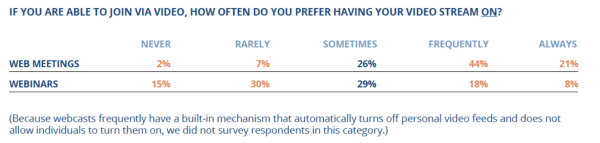
With valid arguments on both sides, how should online convening leaders and facilitators handle this choice? The category and size of your convening can offer some help. Since web meetings tend to be smaller gatherings and usually thrive on high levels of interaction among the participants, these would appear to be times to ask participants to leave their videos on, and our survey respondents agreed: 65% preferred having their videos on frequently or always, and only 9% preferred them on rarely or never during web meetings.
Given a choice of five reasons for preferring videos stay on (with the option to select all that applied and also to enter other reasons not listed), respondents prioritized their reasons as follows:

1. It makes it easier to interact and communicate (84%)

2. It helps me stay focused (60%)

3. If I see other videos on, it feels rude to have mine off (59%)

4. It makes me feel less isolated and more part of a group (57%)

5. It’s required/requested by the facilitator (19%)

Among the “other” reasons respondents provided, noteworthy examples included:

  • “As a leader in my organization I feel it’s appropriate to demonstrate to others that I am ‘present.’”
  • “I want my supervisors to see that I’m engaged.”

And my personal favorite:

  • “You don’t put a paper bag on your head when you meet in person.”

Since webinars often involve larger groups, they would seem to function more smoothly with personal videos turned off, and respondents clearly leaned in this direction: only 26% preferred them on frequently or always, and even more telling, 45% — five times the number of web meetings attendees – said they rarely or never leave their video on.

Given a choice of four reasons for preferring to leave their video off (again with the option to select all that applied and also to enter other reasons not listed), respondents prioritized their reasons as follows:

1. Prefer not to worry about my appearance/attire/background (68%)

2. I’m distracted by my own video (36%)

3. It makes me self-conscious (35%)

4. It’s physically uncomfortable to have to stay within the video frame (27%)

Nearly 40% of respondents who answered this question volunteered other reasons to add to this list, with “bandwidth issues,” “concerns over privacy/security,” “not wishing to be seen multi-tasking,” and “no added value” leading the way.

RECOMMENDATIONS
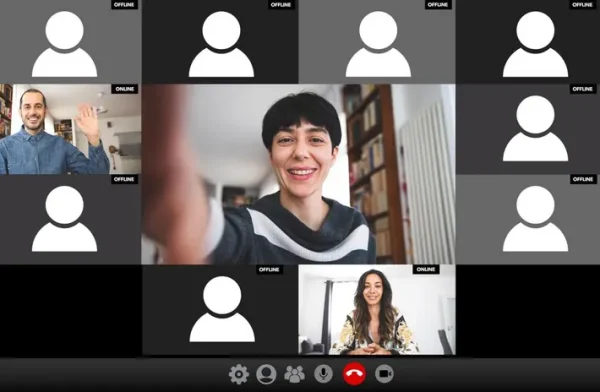
This on/off debate should not be reduced to an either/or proposition. The data for web meetings strongly suggests these are occasions to ask everyone to turn their feeds on, just as the data for webinars indicates that a sizable part of your audience would prefer to leave them off for that kind of convening.

At The Goodman Center, we strive to have the best of both worlds within a single convening. When we begin a webinar (which will usually involve 20-25 participants), we ask everyone to join with their videos on so we can welcome them, and so they can see who else is attending. Once the class is underway and we begin teaching, we ask participants to turn their videos off so we can all focus on the content (which almost always involves PowerPoint slides.) When we stop periodically for questions or discussion, we ask participants to turn their videos on again so everyone can see who’s speaking.

Every request to turn video feeds on or off, however, comes with the option to decline. First and foremost, we believe that people work best and learn more when they feel comfortable and safe. In virtual settings, that feeling begins with how they want to be seen…or not. In addition, be aware that race, gender and age can also affect how individuals approach this decision:

  • While 65% of all respondents prefer to keep their videos on during meetings, a noticeable smaller percentage of people of color (55%) expressed this preference during meetings.
  • Men are more likely than women to prefer having video on during meetings by a small but statistically significant margin: 25.4% to 19.5%.
  • Younger participants are much more likely to feel it’s rude to have their videos off when others have them on when compared to older participants: 77.1% for twenty-somethings versus 49.4% for participants 60+.

Finally, we must all acknowledge the fact that participants in our meeting may be attending many online convenings that day and may simply get tired of being “on camera.” We noted many comments along these lines in our survey, and one in particular jumped out: “My boss makes us keep our video on. I’m on video 5-7 hours a day. It is exhausting. I hate looking at myself all day and fake smiling during Zoom meetings. My head hurts every day. Please make it stop.”

The least we can do is offer that option.

To learn more ways to engage audiences, register for our “Meetings for People Who Hate Meetings” Workshop on May 13 & 15.

How to Get the Most Out of Brainstorming

One of the most popular topics in our class, Meetings for People Who Hate Meetings, is “Rules for Brainstorming”. Even though there is some debate around the effectiveness of group brainstorming, organizations keep scheduling time together to come up with ideas. There’s good reason for this. Whether or not it is the best way to generate problem-solving ideas, brainstorming has side-benefits that make it well worth our time:

  • It is team-building.
  • It builds buy-in for the ideas generated and grown.
  • It can be a democratic way to create things together.

Multi-colored lightbulbs on a flat surfaceThere are rules and guidelines organizations can implement around brainstorming sessions to ensure their usefulness, and we want to highlight one that is do or die: in a brainstorm, everyone is equal. Whether you are the Executive Director or the newest intern, if you are invited to the brainstorm, your thoughts and ideas have equal weight during the exercise.


Now, this rule rarely seems to blow people’s minds. They’ve heard it before, and when they hold a brainstorm, they are sure to start out by telling everyone in the room, “For the next twenty minutes, we want to hear from everyone. We are on an even playing field.” And yet, somehow saying it doesn’t make it so.

The cover of "Invisible Women" by Caroline Criado-Perez

In her book Invisible Women: Data Bias in a World Designed for Men, Caroline Criado-Perez explains why. “[The absence of formal hierarchy] doesn’t actually result in an absence of hierarchy altogether. It just means that the unspoken, implicit, profoundly non-egalitarian structure reasserts itself.” What this boils down to is that getting rid of structure will mean that people who tend to dominate discussion will take over, and you won’t hear from fresh perspectives.

So, instead of simply removing the non-egalitarian structure, we need to replace it with some structure that creates equity. Here are four guidelines you can follow to do just that.

1: Diverse teams drive innovation
Back in 1997 there was a problem in math. No one could figure out how to build a useful model to teach hyperbolic space. (You do not need to understand hyperbolic space to read on – let’s just say it is the very best space.). Mathematician Daina Taimina couldn’t make heads or tails of the only model they had at the time, a flimsy rendering made out of strips of paper and tape. She wondered how on earth she was going to teach the form of hyperbolic space when she couldn’t even imagine it.

As she studied charts and equations, it occurred to Taimina that what she was looking at reminded her of a crochet pattern. So, she spent the weekend crocheting her own model, which has since been adopted widely to help mathematics students experience a visceral connection to an abstract concept. Taimina’s background with crochet, very rare amongst the majority male mathematicians, led to a brilliant innovation in teaching hyperbolic space which is used to study coral reefs and build 3D animations.

The point is, if you want to generate innovation, you need diversity in thought, expression, experience, and background. So, when you are thinking about who to invite to the brainstorm session, consider how you can broaden the diversity of voices in the room.

2: Give people time to prepare.
Sending the subject of your brainstorming session ahead of time will allow people to bring more ideas and better ideas. You can host silent brainstorming time where people are writing down ideas on their own. Silent brainstorming techniques like brainwriting have been shown to increase the number of ideas by as much as 70%. Not everyone does well with on-the-spot thinking, and many people shut down in an environment where you have to break into the conversation to speak. Which brings me to the next tool:

3: Structure idea-sharing time.
You might want to set up a Round Robin where each person has the same amount of time to share their ideas. You can monitor interruptions. In the excitement to build on others’ ideas, brainstorms can grow chaotic. This energy can be perceived and welcomed as creativity, however, oftentimes interruptions prevent the group from hearing from everyone. So next time that bossy-pants in your brainstorm interrupts, you can simply offer that they make themselves a note of their thought and talk about it when it is their turn.

4: Follow Up.
“Including voices from across your organization in brainstorming sessions improves both the quality of the ideas and your organization’s culture. But a lack of communication after the meeting can undo the benefits of a more accessible creative process,” say James Chutter and Jolanta Florian from We {The Collective}. If you want your team to continue to contribute, they need to know that what they share will be listened to, valued and acted upon. If they share ideas and then don’t hear from you again with feedback or progress, next time they will keep their ideas to themselves. No one wants to waste their breath, right?

For the most successful brainstorm, don’t go structure-free. Instead, build an equitable structure that will give you the most bang for your buck, not only in idea generation, but in creating a culture of equity in your organization.

ICYMI: How to Avoid Brainstorming’s Hidden Trap

In Case You Missed It: This article is from our October 1999 edition of our newsletter “Free-Range Thinking.” It is a timeless lesson about effective brainstorming and contains one of our favorite stories.

 You have a tough problem to solve, so you gather your organization’s most creative minds for a full-on brainstorm. You find a comfortable venue, allow plenty of time, eliminate interruptions, and follow all the rules for brainstorming — but when the session is over, your list of possible solutions isn’t worth the easel paper it’s written on. What went wrong?

All too often, even the best-planned sessions fall into one of brainstorming’s hidden traps: starting with the wrong question. It’s an easy mistake to make, and it can be very costly.

Consider the example of The Paradigm Arms, a 10-story apartment building in San Francisco. (Okay, some names have been changed to protect the metaphor, but the numbers that follow are real.) A single elevator served the building’s tenants who openly speculated that theirs was the slowest elevator in all of California. Eventually, snide comments in the lobby turned into an angry letter to the building’s owners, and the time for action was at hand.

The Paradigm Arms was managed by two brothers, Travis and Fred. Travis, the more traditional thinker of the two, immediately saw the straight line connecting problem and solution. He solicited bids from elevator repair companies to modernize the building’s machinery and increase the elevator car’s speed.

The estimates ranged from $150,000 to $200,000 and Travis, nodding to tradition once again, picked one in the middle. For a tidy $175,000 the Paradigm Arms elevator would receive a brand new motor, controller, hoist machinery, brake, guide rails, counterweight rails, and a spanking new buffer (that thing in the basement which keeps the elevator from crashing through the floor and descending into the center of the Earth.)

The machinery was installed, and Travis used a stopwatch to confirm the elevator was, in fact, a few seconds faster from floor to floor. After allowing two weeks of demonstrably improved service, he surveyed the tenants to ensure satisfaction and was stunned by their responses.

Without exception, the tenants saw no difference in service. “Slow as ever,” was the commonly heard response. Travis was stupefied. His stopwatch didn’t lie, and neither did his bank statement which clearly showed $175,000 less in the building’s account.

While Travis stewed, Fred – the free-range thinker of the two – solicited another round of bids. Within a week, the work Fred had ordered was completed, and now the Paradigm Arms had full-length mirrors on either side of the elevator doors on every floor.

Fred circulated a memo to the tenants advising them that technicians had tinkered with the new motor in the elevator. He assured them that the elevator car was moving faster than ever and solicited their comments. No mention was made of the mirrors.

The tenants comments were once again unanimous: “A vast improvement,” they agreed, with some estimating that waiting times had been cut in half. While Fred beamed, Travis began to think he had crossed over into the Bizarro World.

He took out his stopwatch and confirmed that the elevator car was moving no faster than when the new machinery was installed. He pulled Fred aside in the building’s lobby and demanded an explanation. “It’s simple,” Fred explained. “The question wasn’t ‘How do we make the elevator go faster?’ It was ‘How do we make time pass faster for those who are waiting?’”

Fred gestured toward the elevators where a man stood staring into a newly installed mirror, inspecting his suit as he waited. The elevator car arrived, and the doors open and nearly closed before the man realized his wait was over. Travis finally understood, but he had one more question.

“How much for the mirrors?” he asked. “Five thousand, two hundred and sixteen dollars,” Fred replied, unable to conceal a smile. “And that was the high bid.”

Special thanks to Star Elevator in Redwood City, California and Goldon Windows & Mirrors in Troy, Michigan for providing the estimates.

The 21st Annual Summer Reading List

The warm and lengthening days of summer are upon us, and hopefully they bring with them some free time to curl up in the shade with a good book. If your interests tend more toward escape than work, start with

The Storyteller: Tales of Life and Music”(Dey Street Books © 2021) by Foo Fighters front man Dave Grohl.

You’ll meet iconic rock stars through Grohl’s eyes, and even if a who’s who of the music industry doesn’t necessarily appeal to you, Grohl brings such a sense of delight and child-like wonder to every tale that you can’t help but be swept along by his anecdotes. What I loved most, though, was the first section, where he shares short personal stories from his life. As advertised, they paint a “real, raw and honest portrait of an extraordinary life made up of ordinary moments.” You’ll catch yourself grinning as he learns drums by beating on pillows and share his awe at being invited to jam with Iggy Pop. And all the while, I have a hunch you’ll also be learning how to tell stories better.

Of course, if you’d like your summer reading to be a little more on point, we have 3 more suggestions for you.

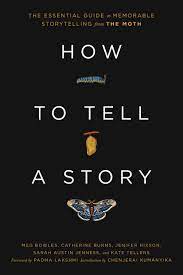
How to Tell a Story: The Essential Guide to Memorable Storytelling from the Moth (Crown Publishing © 2022) by Meg Bowles, Catherine Burns, Jenifer Hixson, Sarah Austin Jenness, and Kate Tellers

Between live shows, podcasts and books, The Moth has made invaluable contributions to the art and tradition of storytelling, and their latest work is no exception. Billed as a how-to, this book delivers when it comes to guiding aspiring storytellers through the steps the Moth team has used so successfully to cultivate and share personal stories.

They illustrate their concepts with excellent examples and helpfully sum up key points at the end of each chapter. I was practically up on my feet cheering through the first chapter that talks about the power of true stories and what happens to humans when they hear or tell stories.

The writers will guide you through structuring your story so that it opens strong, makes sense throughout, keeps the listener engaged using stakes and cliffhangers, and sticks the landing. Their StorySlam how-to poster alone is worth the cost of the book. Here’s an excerpt:

 “What we do want: Hook us in. Make us care about you. Paint the scene. Clearly state your fears, desires, the dilemma. Make us invested in the outcome. Introduce the conflict. Make us worried for you. Impress us with observations that are uniquely yours. Rope us into the moment when it all goes down. Conclude as a different person: Triumphant? Defeated? Befuddled? Enlightened?…CHANGED.”

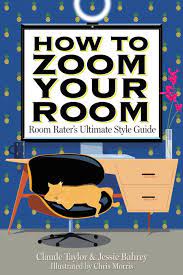
How to Zoom Your Room: Room Rater’s Ultimate Style Guide (Little, Brown & Company © 2022) by Claude Taylor & Jessie Bahrey, Illustrated by Chris Morris

The authors capitalized on our COVID captivity with their popular Twitter feed, “Room Rater,” where they critiqued the Zoom windows of professional broadcasters and pundits. Now you can follow their tips for making sure your Zoom room is a 10/10.

There is helpful advice about choosing the best lighting and angles, avoiding no-no’s like visible lampshade seams and electrical cords (heaven forfend!), and there are even several pages of recipes from former US Senator Claire McCaskill. (I’m not entirely sure why, but I might make that layered strawberry cake.)

Taylor and Bahrey seem to be telling us: make your Zoom room feel like you, and don’t take it too seriously. Frankly, I don’t think “How to Zoom Your Room” is intended as a front-to-back read, so I’d recommend it for a coffee table or your powder room. That said, the book does have a good-looking spine, so I’m putting my copy behind me in my Zoom window.

The Art of Gathering: How We Meet and Why it Matters (Riverhead Books © 2018), by Priya Parker

Yes, the book is four years old, but now that many of us are finally getting together again, the timing feels right to add this title to our reading list. Priya Parker (who has been popping up on several podcasts recently) is a facilitator and strategic advisor trained in group dialogue and conflict resolution. Her work is all about creating “collective meaning in modern life, one gathering a time.”

Parker reminds us that our gatherings can be memorable and even transformative, but only if we do the work beforehand to examine why we are getting together in the first place. She encourages us in “committing to a bold, sharp, purpose,” instead of just meeting out of habit.

As our organizations, families and friends navigate gathering once again, now is a great time to pick up this book, which was named a Best Business Book by NPR, Amazon, Esquire and more.

It may very well help you plan a gathering where every participant leaves thinking, “Now that was worth going to!”