ICYMI: One Simple Question That Can Make or Break a Videoconference

In Case You Missed It: This month’s ICYMI is adapted by a piece written by Andy Goodman in December 2020. In it, we explore the age-old videoconference question: camera on or camera off?
Should I turn my camera on or off? It seems like such a simple question, perhaps even trivial, but in the pursuit of engaging and productive videoconferences, you would be surprised how critical the answer can be. For some attendees, telling them to turn their cameras on can make them feel more included, more connected to other participants, and more focused on the matter at hand. But for an almost equal number, an activated camera can feel like an invasion of privacy, an unblinking spotlight that makes them physically uncomfortable and unable to concentrate fully.

We discovered this sharp divide in the research for our report, “Unmuted: What works, what doesn’t, and how we can all do better when working together online.” We also learned that there are different ways to answer this question depending on the kind of online convening you’re conducting.

Q: Should I turn my camera on or off?

A: Yes!

The kind and size of your online convening can provide useful guidelines here, but whenever possible, let your participants decide for themselves.

There was a distinct split in our survey between those who wanted to keep their video feeds on and those who preferred having them off. The On-ers noted how it improves interpersonal communication and can contribute to a greater feeling of community. The Off-ers cited how distracting these videos can be and also how they can contribute to a loss of privacy.

When I spoke with Matt Claps of Casey Family Programs, he diplomatically captured both sides of this split: “It’s part of [Casey’s] culture to recognize we’re working in someone’s personal space, so we allow people to turn off cameras and mute,” he said during our Zoom interview. “But that does present a challenge of losing the nonverbal communication you usually have when you can see the person you’re speaking with.”

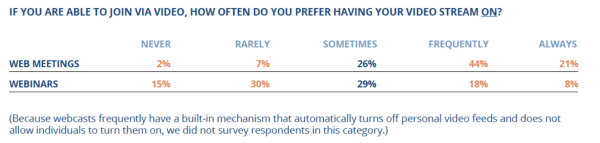
With valid arguments on both sides, how should online convening leaders and facilitators handle this choice? The category and size of your convening can offer some help. Since web meetings tend to be smaller gatherings and usually thrive on high levels of interaction among the participants, these would appear to be times to ask participants to leave their videos on, and our survey respondents agreed: 65% preferred having their videos on frequently or always, and only 9% preferred them on rarely or never during web meetings.
Given a choice of five reasons for preferring videos stay on (with the option to select all that applied and also to enter other reasons not listed), respondents prioritized their reasons as follows:

1. It makes it easier to interact and communicate (84%)

2. It helps me stay focused (60%)

3. If I see other videos on, it feels rude to have mine off (59%)

4. It makes me feel less isolated and more part of a group (57%)

5. It’s required/requested by the facilitator (19%)

Among the “other” reasons respondents provided, noteworthy examples included:

  • “As a leader in my organization I feel it’s appropriate to demonstrate to others that I am ‘present.’”
  • “I want my supervisors to see that I’m engaged.”

And my personal favorite:

  • “You don’t put a paper bag on your head when you meet in person.”

Since webinars often involve larger groups, they would seem to function more smoothly with personal videos turned off, and respondents clearly leaned in this direction: only 26% preferred them on frequently or always, and even more telling, 45% — five times the number of web meetings attendees – said they rarely or never leave their video on.

Given a choice of four reasons for preferring to leave their video off (again with the option to select all that applied and also to enter other reasons not listed), respondents prioritized their reasons as follows:

1. Prefer not to worry about my appearance/attire/background (68%)

2. I’m distracted by my own video (36%)

3. It makes me self-conscious (35%)

4. It’s physically uncomfortable to have to stay within the video frame (27%)

Nearly 40% of respondents who answered this question volunteered other reasons to add to this list, with “bandwidth issues,” “concerns over privacy/security,” “not wishing to be seen multi-tasking,” and “no added value” leading the way.

RECOMMENDATIONS
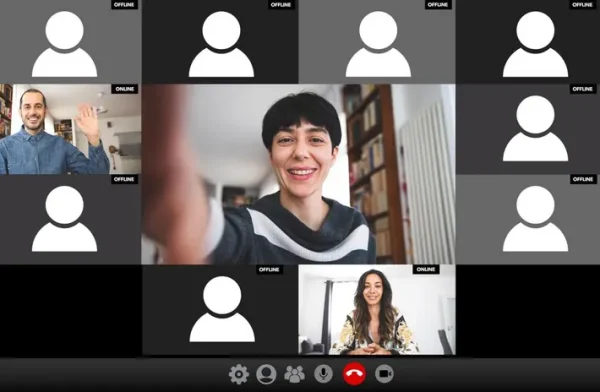
This on/off debate should not be reduced to an either/or proposition. The data for web meetings strongly suggests these are occasions to ask everyone to turn their feeds on, just as the data for webinars indicates that a sizable part of your audience would prefer to leave them off for that kind of convening.

At The Goodman Center, we strive to have the best of both worlds within a single convening. When we begin a webinar (which will usually involve 20-25 participants), we ask everyone to join with their videos on so we can welcome them, and so they can see who else is attending. Once the class is underway and we begin teaching, we ask participants to turn their videos off so we can all focus on the content (which almost always involves PowerPoint slides.) When we stop periodically for questions or discussion, we ask participants to turn their videos on again so everyone can see who’s speaking.

Every request to turn video feeds on or off, however, comes with the option to decline. First and foremost, we believe that people work best and learn more when they feel comfortable and safe. In virtual settings, that feeling begins with how they want to be seen…or not. In addition, be aware that race, gender and age can also affect how individuals approach this decision:

  • While 65% of all respondents prefer to keep their videos on during meetings, a noticeable smaller percentage of people of color (55%) expressed this preference during meetings.
  • Men are more likely than women to prefer having video on during meetings by a small but statistically significant margin: 25.4% to 19.5%.
  • Younger participants are much more likely to feel it’s rude to have their videos off when others have them on when compared to older participants: 77.1% for twenty-somethings versus 49.4% for participants 60+.

Finally, we must all acknowledge the fact that participants in our meeting may be attending many online convenings that day and may simply get tired of being “on camera.” We noted many comments along these lines in our survey, and one in particular jumped out: “My boss makes us keep our video on. I’m on video 5-7 hours a day. It is exhausting. I hate looking at myself all day and fake smiling during Zoom meetings. My head hurts every day. Please make it stop.”

The least we can do is offer that option.

To learn more ways to engage audiences, register for our “Meetings for People Who Hate Meetings” Workshop on May 13 & 15.
Get Story-Inspired by Girls For A Change

If you need some storytelling inspiration, look to Angela Patton. In March, I was facilitating a virtual storytelling training for 159 nonprofit leaders across the country including Patton’s organization, Girls For A Change (GFAC). To prepare, I pulled on my proverbial headlamp and mined each organization’s website for great stories or great storytelling opportunities. When I got to GFAC, I struck gold.  

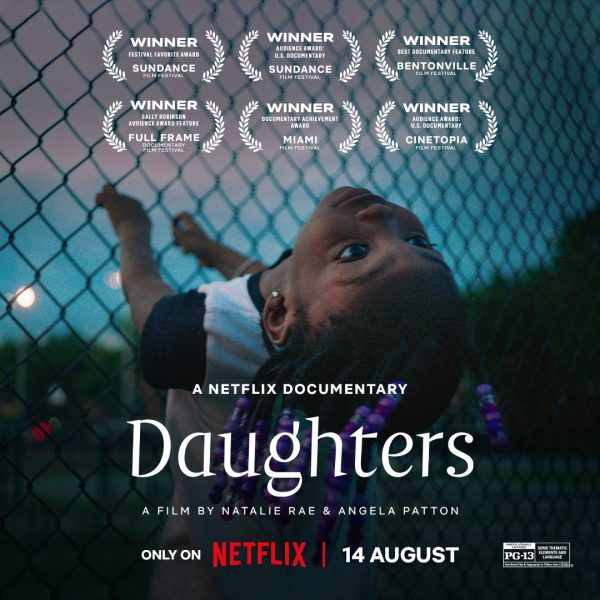
On the front page of their site is a poster for Daughters, an award-winning documentary co-directed by Patton, which tells the stories of four girls participating in GFAC’s program, Date With Dad. I decided to watch a few minutes of it for research, but I couldn’t turn it off.  

As phenomenal as this film is (put it at the top of your list!), I didn’t think that I could go into a training and tell 158 other organizations, “You should all make Netflix documentaries using the power of dramatic narrative. It’s easy!” Ummm… no. 

While Daughters was her directorial debut, Patton has been putting storytelling to work for over a decade. In her 2012 TedTalk she shared stories that would become part of the documentary. In it, she creates vivid moments that connect deeply to the hearts and imaginations of the audience. During that training last month, I showed a clip of Patton’s TedTalk and asked her to share how storytelling has played a role in her work.  

I was spellbound by her response, so I asked her if she’d be willing to share her experiences in this month’s newsletter.  

Kirsten: What role does human-centered storytelling play in your work?  

Angela: Storytelling is at the heart of everything we do. At Girls For A Change, our guiding principles are: Tell Compelling Stories, Inspire Real Action, Dream of Black Excellence, and Dial up the Fun. Our mission is simple: “Prepare Black girls for the world, and the world for Black girls.” We center Black girls in community and co-create stories with them, always following their lead. It’s about amplifying their voices and ensuring their stories are shared on their terms. I also share my own lived experiences, and together, we learn, grow, and heal from each other’s stories. The world deserves to hear the stories they feel ready to share. 

Kirsten: How has telling this kind of story changed you, your work, or your audiences?  

Angela: Filmmaking is just one form of storytelling, but it has given us the opportunity to bring Black girls’ truths to a broader audience. We are opening doors into rooms where these conversations were often missing. We’ve seen audiences deeply moved, with people sending letters, making donations, and offering support because they saw themselves in the girls’ stories. This work resonates with so many because it’s rooted in family healing and love—universal emotions that connect us all, regardless of background. 

Kirsten: I have seen your TedTalk, Daughters, and the videos on your website. Are there other ways you use personal storytelling?    

Angela: Storytelling is woven into everything I do. It’s in pitch decks, at events, and in conversations to recruit girls and their families. We use storytelling to celebrate girls and their journeys at the end of our programs. It’s the way we connect, honor, and uplift them throughout their time with us. 

Kirsten: What have been the barriers or challenges in sharing stories?    

Angela: Not everyone will get on board or agree with your story. This is part of the work of movement-making. Many don’t want to hear our stories, and it can be challenging to get people to see and resonate with Black stories—let alone support them. But if you stay grounded in the belief that your story matters, and stay the course, you will end up where you need to be. 

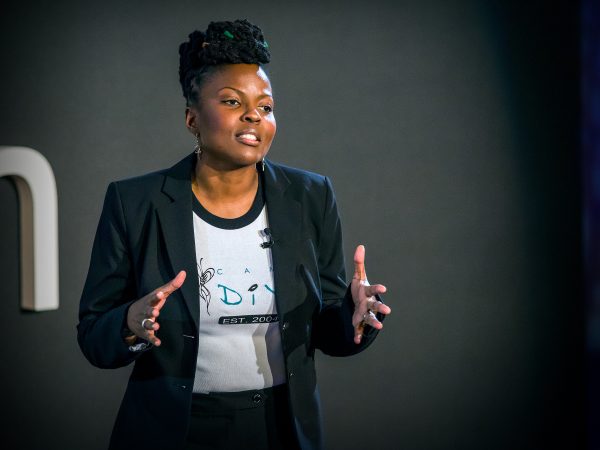
Angela Patton

Kirsten: So many nonprofits and foundations fall into deficit framing in their stories—where we meet people at a low point and the programs lift them up. Your stories don’t do that. You introduce girls in your stories using asset framing. We meet the girls first as beautiful people with skills and aspirations. Is that something that you did naturally? Did you learn about that? Or both?   

Angela: At Girls For A Change, we introduce girls with their joy, dreams, and talents. This approach is something that comes naturally to me. From a young age, I saw the media—TV, billboards, magazines—and recognized that they often didn’t represent me or my community. What was being shown wasn’t true, and I wanted to change that. I’ve always fought against that narrative. When I started GFAC, I quickly realized that the girls we serve also had their own stories, stories filled with hope, creativity, and resilience, and it was my job to be an active listener. I understood that these stories were part of a broader picture, and that the world needed to hear them. It wasn’t just about us telling stories—it was about everyone being involved in the process. Building trust is essential to uncovering the real story. Without that, we would miss the richness and depth of who these girls truly are. 

Kirsten: Any advice for leaders or comms peeps when it comes to gathering and telling stories that really bring you inside moments with people?    

Angela: Building trust is paramount. When someone shares their story with you, it’s crucial to understand that they are not just a prop for your narrative. Don’t pigeonhole them into a box. Ask yourself: How can you offer something of real value in return for their trust? For Daughters, we spent time listening, building trust, and then finding opportunities to offer support. We started an Education Fund, we check-in regularly, offer stipends for speaking engagements, and share resources. Even if it’s not financial support, there are always doors you can open and resources you can share. Patience is also key—it’s a marathon, not a sprint. It takes time to build the relationship and truly understand what they need. Listen closely and be patient. You can’t rush trust. 

To learn more ways to create and share impactful stories, register for our “Storytelling: Tapping the Power of Narrative” Workshop on May 13, 20, 27, and June 3.

ICYMI: Why Most Videoconferences Aren’t as Inclusive as They Could Be (And How We Can All Do Better)

In Case You Missed It: This month’s ICYMI was written by Andy Goodman in November 2020. In it, he explores where there is room for improvement when it comes to accessibility for all in meetings.

Creating an inclusive atmosphere in which everyone present feels not only welcomed but valued can be challenging under the best circumstances. Remove the opportunities that come naturally when meeting in person – one-on-one chats, reading body language, sensing a group’s energy level – and it can feel almost impossible. In our report, “Unmuted,” which looks at the challenges videoconferencing presents, we heard this lament frequently from meeting leaders and facilitators.

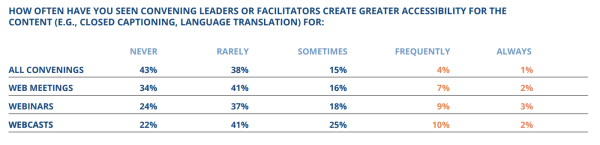
Consequently, you might expect that those responsible for conducting videoconferences would use every tool and technique available to enhance inclusivity, and our research confirmed that they are…to some degree. But when it comes to using the tools specifically designed to include participants who may have difficulty seeing what’s being shown, hearing what’s being said, or fully understanding the language being spoken, most videoconferences miss the mark by a wide margin. Consider the responses below to a question in our survey about efforts to enhance accessibility:

When only 12% of respondents reported that they observed webinar or webcast leaders “frequently” or “always” taking steps to create greater accessibility – and that’s the highest score across all categories of online convenings – clearly we are not prioritizing these activities. And what’s even more disappointing is that the most popular videoconferencing platforms all have a variety of accessibility tools readily available.

During the last week of October, we visited five videoconferencing platforms our survey respondents reported using most frequently to learn exactly which tools they provided. The built-in choices are abundant and include tools such as closed captioning, recordings with transcripts, high contrast mode, screen readers and magnifiers, and more. (Please note that the options available to your organization may vary with your level of service.) If you haven’t done so already, take the time to learn your options: here are links to the pages specifically dedicated to accessibility tools for Zoom, Webex, Microsoft Teams, GoToMeeting, and Google Meet.

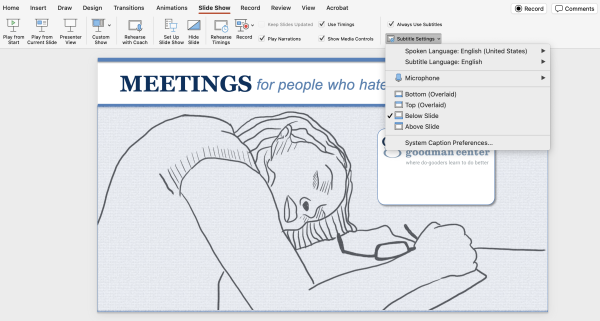
Your efforts at enhancing accessibility don’t have to end there. PowerPoint can increase accessibility when slides are part of your convening. Thanks to recent improvements by Microsoft, you can now set up your PowerPoint presentations to provide real-time subtitles for the speaker’s narration in either the speaker’s language or translated into any of 70 other languages. (And if you have access to PowerPoint Live Presentation, each audience member can can have the narration translated into the language of their choice.)

Two other resources to consider: U.S. government agencies are required by Section 508 of the Rehabilitation Act to ensure that communication materials such as PowerPoint slides are fully accessible to people with disabilities. Guidelines on text, object and color formatting and other design aspects can be found at www.section508.gov. And even if you don’t work for the government, these are useful standards for evaluating the accessibility of your slides.

Finally, WebAIM (an acronym for “Web Accessibility in Mind”) is a site maintained by the Center for Persons with Disabilities at Utah State University that offers training, consulting, evaluation and certification for organizations who are interested in enhancing the accessibility of all their web-based convenings and programs.

When meetings, presentations, trainings and just about everything you do move online, you face an entirely new set of challenges. How do you read the room when the “room” is a grid of faces on a computer screen? How do you keep remote workers engaged when the opportunity to multitask is constant? And how long can your team be productive when everything that was face-to-face is now conducted screen-to-screen?

To answer these and other equally daunting questions, we turned to the people at nonprofits and foundations, colleges and universities, and government agencies at all levels who are facing these challenges every day. Over 4,400 participated in our survey, and what they told us is summarized in our new report, “Unmuted: What works, what doesn’t, and how we can all do better when working together online.”

To learn more ways to make your meetings more inclusive, register for our “Meetings for People Who Hate Meetings” Workshop on May 13 & 15.
Three Ways Improv Can Improve Meetings

Often when we gather for full team meetings, we are asked to dream up ways to innovate and overcome  roadblocks so that our programs, outreach, and fundraising feel fresh. But what do you do when the “idea well” seems to run dry? Here are three tools from improvisation that you and your team can use during your next brainstorm to develop a mindset of collaborative creativity. 

1) Yes, And 

Ever heard the adage “in a brainstorm, there are no bad ideas”? If you’ve scoffed at that pithy phrase, you are not alone. Yet, professionals in improvisational theatre know through experience that, while it may sound corny, it is true. What makes an idea fall flat isn’t its inherent value (or lack thereof) but how it is received and built upon. If we say “yes, and” to the ideas from our colleagues, we discover that idea that we thought was worthless as a rock is a total gem.

Here’s what not to do: 

Jalen: Ok, we are having a hard time selling tables for our fundraiser. What if we named each table something fun? 

Marcia: (barely suppresses an eyeroll) I don’t really see how a fun name is going to sell a $30,000 table. 

Brainstorm over. 

Here’s how to do it: literally say “yes, and,” and then add something to the mix. 

Jalen: Ok, we are having a hard time selling tables for our fundraiser. What if we named each table something fun? 

Marcia: Yes, and what if the fun names were connected to students who graduated our last cohort? 

Jalen: Yes, and what if those students could guest at the tables as ambassadors? 

Saying “Yes, And” invites collaboration, inspires more ideas, and cultivates safe space for putting your ideas out there. At Pixar, where folks know a thing or two about creativity, they call this “plussing.” Their plussing rule (also inspired by improv theatre) is that you can’t eliminate or criticize an idea without first saying something you like about it and adding a twist.

2) Listen First 

We all know the feeling of trying to work with someone who is just waiting for us to stop talking so that they can talk. (If you don’t know, uh-oh, it might be you.) There is no collaboration without listening. However, listening isn’t always as easy as it sounds. It takes practice and training. 

One exercise we do as improvisers is to create a scene in which every sentence has to start with the last word of the sentence before. That prevents the improviser from planning ahead because they literally don’t know what word they are going to need to use. They have to listen.

In a meeting, you can use this same idea. Instead of starting your sentence with the last word someone used, you can sum up or reflect on what you heard from the other person. In The Facilitator’s Guide to Participatory Decision Making, they call this paraphrasing and recommend it as one of their “techniques for honoring all points of view.”  

Here’s what not to do: 

Jalen: What if we named each table something fun? 

Marcia: I think we should post a tiktok about the event every day this week. 

Here’s how to do it: 

Jalen: What if we named each table something fun? 

Marcia: Ooh, Jalen, I hear you think fun table names would draw some interest. I had been thinking about how we can drive attention on social media. I wonder if somehow those ideas can work together. 

Please note that when you paraphrase someone’s idea you attribute their idea to them. Not only do you avoid being a jerk, but positive acknowledgement might encourage more people to share ideas. 

3) We Can If 

At times, our problem-solving sessions get tense. We have narrowed down our ideas to a couple and those seem to be competing. There are entrenched camps for Marcia’s idea and Jalen’s idea. Each camp only shares what is wrong with the other camp’s idea. 

Here’s what not to do: 

Jalen: This TikTok idea is a nonstarter. We don’t have time to do the posts, we don’t even have an idea yet for the posts, and I don’t know if our donors are even on TikTok. 

Marcia: It’s better than fun table names. We don’t know what names and who would care about that. That’s a very surface solution. 

You might be thinking that Jalen and Marcia each have some good points, but they are not moving the conversation forward. Instead, they could use “We Can If…” which comes from A Beautiful Constraint by Adam Morgan and Mark Barden. They describe how this tool can “[keep] the conversation focused on movement towards possible solutions, unchecked by the presentation of potential problems.” I learned about it from one of my improv mentors at Impro Theatre as a method for training your brain to live in a space of “yes.” 

Here’s how to do it: Use “we can if” to reframe your concerns so that you keep the creativity flowing. 

Jalen: Ok, let’s explore Marcia’s TikTok idea. I think we can if we come up with a compelling thread for the posts. We can if we lighten up our social media intern’s duties for the week, and we can if there’s a way to directly share the posts with our key leads.

Now Jalen is collaborating instead of being a roadblock. They may not end up doing the TikToks, but they will have learned more about their strategy and resources by going through the process.  

Creativity is not just a gift; it is a practice. Give one of these exercises a try if you want to replenish your well of creative collaboration. 

ICYMI: Say the Words. Show the Pictures

In Case You Missed It: This month’s ICYMI is adapted from a piece written by Andy Goodman in January 2006. In it, we dissect the cons of text-heavy PowerPoint slides.

Bad PowerPoint presentations waste time. For businesses and nonprofits alike, time is money. Tedious slide shows not only bore everyone, they also drain dollars from an organization’s bottom line. The question is: exactly how much money are these bad PowerPoints costing? In 2004, Max Atkinson calculated one answer.

A UK-based presenting and public-speaking coach, Atkinson derived a formula to determine how much money PowerPoint was costing the British economy in a single year. “If you take the number of managers in the country earning 30,000 pounds a year or more,” he says, “[assume they attend] one presentation for one hour a week, and you know 90% of the presentations bore them and they get nothing out of them, the answer is 7.8 billion pounds.” Or roughly 14.2 billion US dollars.

With no dollars to waste, non-profiteers need to take a closer look at how their organizations use PowerPoint. If your slideshows feature few images, scads of text, and your presenters are reading that text to the audience, wasting time and money is not your only problem. These presentations are actually making it harder for the audiences to learn – a fact that was proven in 1998 and reported in Richard Mayer’s eye-opening book, Multimedia Learning.

The people in your audience have two channels for processing information: visual and auditory. These channels work simultaneously, so audience members are perfectly capable of looking at a slide, listening to the presenter, and making sense from both streams of information. These same people can run into trouble, however, when they have too much information to process at one time.

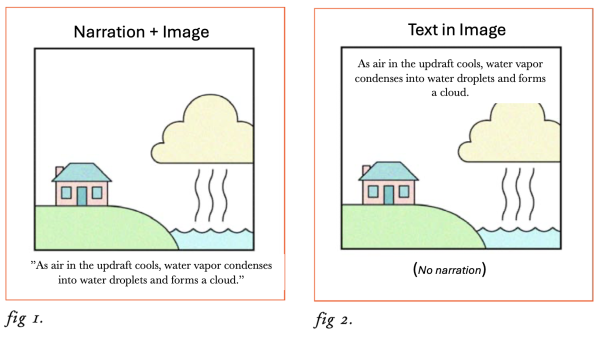
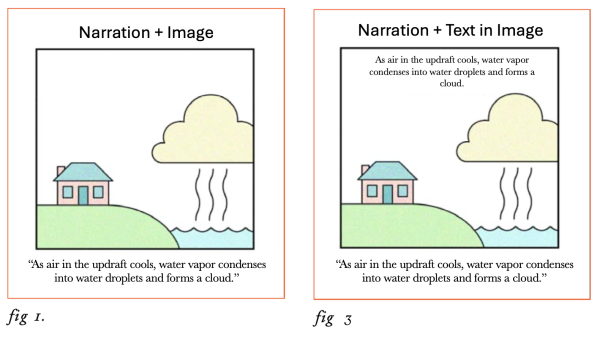
How much is too much? In 1998, Richard Mayer conducted a series of tests on college students to answer this question. Mayer created two sets of slides to teach students how lightning storms develop. The first set was comprised only of images (see figure 1) and as each slide was shown to the students, a narrator explained what the image was depicting. The second set of slides had the same images, but in this set the explanation was printed on the slide for the student to read (see figure 2). No narration accompanied these slides.

After reviewing the slides, the students were tested for retention of the information they had just been given. Even though the images and explanations were identical, the students who saw the images and heard the narrated explanation retained more than the students who saw the images and read the explanation themselves. Mayer repeated the test four times and obtained the same result every time. His conclusion: presenting a picture with narration allows the two information processing channels to work collaboratively. Presenting a picture with text overloads the visual channel (while ignoring the auditory channel) and can actually hinder learning.

To further test this theory, Mayer ran another side-by-side experiment with one critical difference. As before, the first set of slides showed images only accompanied by voice narration. The second set showed images with text, but this time narration was included as well (see figure 3). Once again, the students who saw the first set of slides retained more than those viewing the second set.

From these results, Mayer concluded that students viewing the second set of slides were hindered by two problems. As before, their visual processing channel was over-loaded with information. And instead of opening a second channel for learning, the narrator’s voice further aggravated the situation. When people read text on a screen while a presenter intones those same words aloud, Mayer asserts, the audience’s tendency is to listen for differences to determine if the printed and spoken words are, in fact, the same. And that means the audience is not focusing on the content!

“When making a multimedia presentation consisting of animation and words,” Mayer writes in his book, Multimedia Learning, “present the words as narration rather than on-screen text.” Like any rule, there are exceptions here as well, but as a general guideline for the design of PowerPoint slides, Mayer’s advice is worth heeding.

To learn more ways to engage audiences, register for our “Meetings for People Who Hate Meetings” Workshop on March 25 & 27.

The Secret to a Great Story? Location Location Location

“Jen is tired from a long week of ten-hour days and seemingly endless subway delays. She winds her way through bustling Times Square, skillfully maneuvering around the tourists gawking at the towering skyscrapers above as she rushes into work. Her well-tailored coat nearly gets caught in the closing elevator doors as she squeezes in. She almost falls into a bike messenger balancing too many packages.”

We are inside what could be the beginning of almost any romcom (after all, it’s February!). 

Action, drama, mystery, romance, memoir. As different as these genres may seem, they all start with a where. A good where is a non-geographical location (i.e. an office, a kitchen, or a classroom) that serves as the setting for the story. The where invites us to come inside with the characters. It is the first building block to story structure 

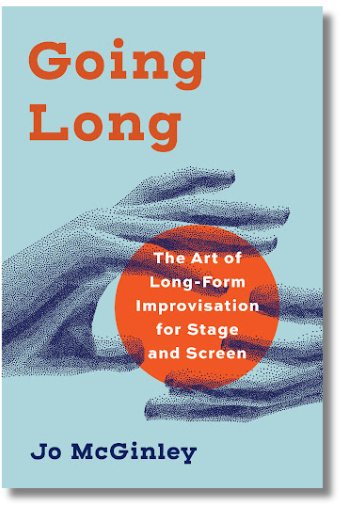
I recently read “Going Long” by Jo McGinley, one of my dearest improv mentors. Her excellent book reminded me that “knowing where you are is a launching pad… It pulls [the audience in] and immediately gives you a structure to work with… we are somewhere specific so [the audience’s] minds are engaged.”

Establishing the where is the very first thing in so many great movies and books, but it is often missing altogether in the stories we tell for our organizations. 

Instead, many start their stories with a data point. An impact story on the website of a nonprofit often begins with something like this: “In Charles County 12% of the population lives in poverty. The small rural county with a population of just 58,000 has an ALICE percentage of 38% and a very busy Care Together chapter addressing needs.”  

These facts are then followed by a whole paragraph giving more context and data and eventually get to a story about an event at which the local organization (I’m calling them “Care Together”) and their partners distributed 350 backpacks filled with essential school supplies to students. No doubt, those backpacks made a big difference to those kids and their families. We learn the facts about this event, but we aren’t carried inside of it. We might recognize the good accomplished, but could we feel it more strongly? 

A where isn’t simply a geographic location–it’s setting the scene and painting a picture for the reader. Charles County is a place, but not a where. The gym with a pile of backpacks Tina navigates while a line of people snakes around the basketball court is the where. Like you create a set for a movie, you are bringing the audience into a specific time and place where the action is happening. 

If you want to pull your audience inside, borrow from the best storytellers and start your story with a where. Tina steadies the tower of backpacks as she pulls a blue canvas one from the pile. Behind her, folding tables and tents have been set up on the basketball court of Charles Elementary. Tina swings the backpack, heavy with school supplies, onto her shoulder and carries it towards the next family waiting at her station.” 

Once the audience is brought into the world of the story, then you can add the data you want, being careful not to burst the delicate bubble of the narrative. “In a small rural county with a population of just 58,000, Tina wouldn’t expect so many families to be in need, but 38% of people in Charles County are Asset Limited, Income Constrained, and Employed—what Care Together calls ALICE. Tina glances from the line winding around the free-throw line back to the pile of backpacks. She hopes there’s enough for everyone.”

The where is a powerful tool. Include a where in your success stories. Ask about the where when  gathering a testimonial. Bring your audience into a where during a presentation. Don’t leave your audience hanging out in the wind. If you have no where, you have no story. 

So, next time you are wondering, “how do I tell this story?” Start with where. 

Want to practice the where of your story and hone other storytelling skills? Sign up for our next “Storytelling: Tapping the Power of Narrative” workshop on May 13, 20, 27 & June 3.

ICYMI: The Activation Point – Why You Need to Find It

In Case You Missed It: This month’s ICYMI was written by Andy Goodman in December 2006, as he sat down with communications expert Kristen Grimm to discuss the gap between caring and doing.

Even when your target audience is informed and concerned, they can remain stuck in neutral. Learn how to find their activation point, however, and you can shift them into drive when you need them most.

Kristen Grimm’s personal activation point was a phone call. “I remember being on a conference call with a nonprofit when someone said their issue was polling really well, so they were sure their audience was ready to act.” As president of Spitfire Strategies, a communications firm with extensive experience in public interest campaigns, Grimm was not so sure, and she had heard that kind of optimistic prediction once too often.

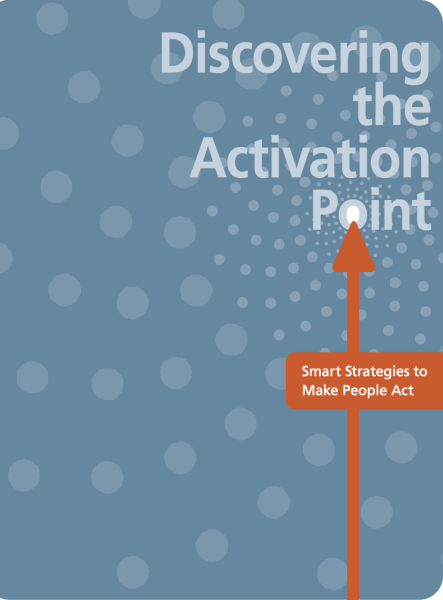
“I kept seeing this big disconnect between what people say they care about and what they’re ready to do,” Grimm says. So, with backing from three foundations and advice from a panel of communication experts, Grimm set out to study this frustrating gap between caring and doing. The result is Discovering the Activation Point: Smart Strategies to Make People Act.

In November, as the new study was being readied for publication, I asked Grimm what readers could expect to learn from her research. Her answers are inside along with an excerpt from Chapter II, “Testing the Temperature.”

Goodman: So let’s start with the obvious question – what is the “activation point”?

Grimm: The activation point occurs when the right people at the right time are persuaded to take an action that leads to measurable social change.

What’s the difference between an activation point and a tipping point?

With a tipping point, the social change is going to happen because people are already moving in this direction. The activation point is the architecture for getting to the tipping point. It’s what starts people moving in the right direction.

You talk a good deal about persuasion in the study. Do some nonprofits consider this a dirty word? 

Persuasion has become mixed up in some people’s minds as manipulation, and there’s a big difference. Manipulation usually implies lying and convincing people to act against their own interests. Persuasion is very different, and we wanted to give some very specific advice about how to do it. If knowledge alone were enough to inspire action, the world would already be a better place, but that’s not what we’re seeing. You have to plan for persuasion.

Who can benefit from reading this study?

Nonprofits and the foundations that support them. But keep in mind we’re talking about issues that people know a lot about and say they care about. If your issue is one with low knowledge or a lot of “swing voters,” you may not be at a place where you’ll be able to use this.

And the obvious last question: how does someone get a copy?

You can download a PDF version at www.communicationsleadership.org.

The following is an excerpt from Discovering the Activation Point: Smart Strategies to Make People Act, published by the Communications Leadership Institute and Spitfire Strategies with support from the David and Lucile Packard Foundation, Open Society Institute, and the Robert Wood Johnson Foundation.

Our research demonstrated that hope is a powerful incentive for bringing a person to an activation point. The stronger the hope, the more likely the action. A sense of possibility enhances one’s desire to help. In fact, hope is a critical concept — among the most frequently named in conversations about emotions.

Not surprisingly, hope emerges when a person feels in control, while hopelessness arises when people feel no control over adverse outcomes. Any successful call to action must build upon a sense of possibility. The audience target must believe it can make a difference and expect a positive outcome. Albert Bandura, a renowned social-learning psychologist at Stanford University, suggests that organizers initially structure situations “to bring success; don’t prematurely put them in situations where they are likely to fail.” Disease groups trigger this sense of hope when they talk about someday finding a cure.

The Living Wage campaign uses hope as an activation point. In Florida in 2003, a broad coalition of labor unions, community organizations, churches, senior citizen groups and others set out to offer a living-wage referendum to voters to raise the state’s minimum wage to $6.15 an hour. They made it clear that raising the minimum wage would help everyone. They called the campaign Floridians for All. They faced considerable and well-funded opposition from the powerful restaurant and tourism industries. But the campaign tapped hope for economic improvement for low-income families, and hope for success at the ballot box to move the effort forward. The minimum wage measures won in every county in Florida, even the most conservative.

On the other hand, some rhetoric is devoid of hope. The Institute for Public Policy Research in the U.K. tracked rhetoric around global climate change and found one pervasive pessimistic model described as follows in the Warm Words report:

“Climate change is most commonly constructed through the alarmist repertoire— as awesome, terrible, immense and beyond human control. It employs a quasi-religious register of death and doom, and it uses language of acceleration and irreversibility. It contains an implicit counsel of despair — ‘The problem is just too big for us to take on.’ Its sensationalism and connection with the unreality of Hollywood films also distances people from the issue. In this awesome form, alarmism might even become secretly thrilling — effectively a form of ‘climate porn.’ It also positions climate change as yet another apocalyptic construction that is perhaps a figment of our cultural imaginations, further undermining its ability to help bring about action.”

The problem with this model of rhetoric is that it emphasizes that the problem is too big to solve. People can either panic or dismiss the problem. Very few say to themselves,“I will be the one to fix this insurmountable challenge.” Instilling hope means showing audience targets that change is possible. Optimism is a critical component of persuasion.

Scary Tales of a Far-Right America

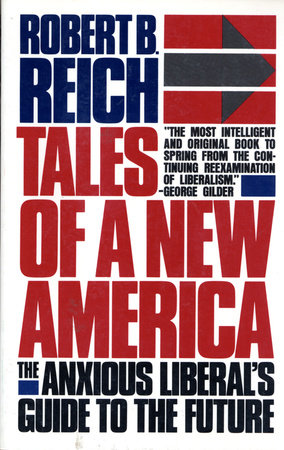
In his book, Tales of a New America, former Secretary of Labor Robert Reich asserted that four narratives have guided and shaped this nation’s life since its colonial days. “The Triumphant Individual” narrative includes stories reassuring us that anyone can make it here – just grab your bootstraps and pull! Stories about “The Benevolent Community” remind us that Americans are a good and generous people who will always lend a hand to neighbors in need. “The Mob at the Gates” stories warn that we must always be on guard against outsiders who would threaten our safety and security. And a similar set of cautionary tales, “Rot at the Top,” turns the focus inside the gates to expose corruption in government, business, and other internal centers of power.  

I was reminded of Reich’s book last month when I watched a presentation entitled “Far-Right Media & The Power of Narrative.” Hosted by Spitfire Strategies, the presentation shared the top take-aways of an eye-opening study funded by the Lumina Foundation and conducted by Protagonist, a firm that analyzes narratives driving human behavior.

Just as Reich did, Protagonist identified four narratives that are guiding and shaping American discourse – but with a critical difference. Rather than originating naturally over centuries, these far-right narratives have been deliberately constructed and disseminated for specific political and ideological purposes.

Call them “Scary Tales of a Far-Right America,” and ignore them at your peril, because it’s quite possible they are undermining your work as you read this. 

For this study, Protagonist’s researchers reviewed 2.2 million articles, broadcast news reports, commentaries, andother pieces disseminated between January 2020 and September 2023 by Fox News, Breitbart, The New York Post, Heritage Foundation,  and others – 38 far-right sources in all. The major topics covered by these stories included politics, education, immigration, race, religion, the economy, democracy, climate change and others. From all these stories four narratives emerged: (the text defining each of the narratives below is taken verbatim from Protagonist’s presentation) 


  • Reject the Woke Agenda 

The radical and all-powerful Left is waging a mass indoctrination campaign that is silencing Conservatives and threatening the sacred values of our nation.  

  • Americans Under Siege 

Chaos, crime, and violence have descended on this country, and Americans live amid constant threat of physical harm. 

  • Expose the Deception 

We must open our eyes and resist efforts by Democrats, elites, and corporations to pull the wool over our eyes and amass power. 

  • Preserve Capitalism

In order to keep our country strong and prosperous, we must not lose track of our commitment to hard work, self-determination, and a free market. 

These four narratives can work individually or in combination. For example, arguments that climate change is a hoax which restricts drilling for oil and hurts the economy tap into both the “Expose the Deception” and “Preserve Capitalism” narratives. 

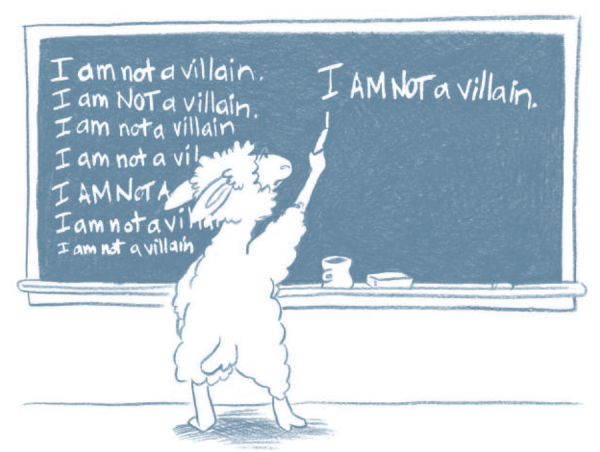
Protagonist also found that many of these narratives created clearly identifiable villains, putting human faces on otherwise abstract subjects, making them easier for audiences to emotionally connect with (and become enraged by.)Don’t like the government telling you to get vaccinated? Blame Anthony Fauci!  

Another tactic connected with these narratives is the poisoning of key terms associated with progressive ideals: DEI, CRT, affirmative action, and others. Far-right outlets are using every opportunity to make these terms so toxic that they can no longer be used. (In a similar vein, Florida Governor Ron DeSantis signed a law in May 2024 banning the use of the words “climate change” in any statewide statutes.) 

Protagonist is already looking at left-leaning outlets to identify narratives on the progressive side of the ideological spectrum, and results of that research will be forthcoming later this year.

So, what do you do in the meantime? The first step in dealing with any problem is acknowledging that you have a problem, and clearly we have one here. These narratives comprise a well-orchestrated, relentless, and emotionally powerful attack on progressive values and causes. It requires the same in response.  

Who’s in? 

To learn more about the webinar “Far-Right Media & The Power of Narrative” send an email to narrative@spitfirestrategies.com. Special thanks to Nima Shirazi of Spitfire for his assistance with this article.

ICYMI: Why We Are “Wired for Story”

In Case You Missed It: This month’s ICYMI was written by Andy Goodman in May 2012, as he sits down with story expert Lisa Cron to discuss audiences’ craving for stories.

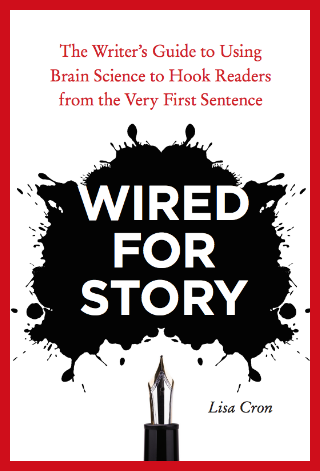
I devour books about storytelling, and Lisa Cron’s Wired for Story: The Writer’s Guide to Using Brain Science to Hook Readers from the Very First Sentence is a meal and a half. I took copious notes starting on page one where I was stopped cold by this insight: “Story, as it turns out, was crucial to our evolution – more so than opposable thumbs. Opposable thumbs let us hang on; story told us what to hang on to.”

Cron currently teaches storytelling at the UCLA Extension Writers’ Program, and she honed her skills as a story consultant for Warner Brothers, the William Morris Agency, and other Hollywood institutions. Recently, we sat down to lunch in Los Angeles and talked about her new book.

Goodman: I’ve read many books about the craft of storytelling, but this is the first I’ve seen that examines it through the lens of neuroscience. What got you interested in this kind of research?

Cron: For decades a big part of my job was to read manuscripts and screenplays and evaluate them. Most of them were really bad, so this almost always translated into figuring out why they didn’t work. It wasn’t long before I noticed something curious: while each story that didn’t meet my expectations crashed and burned in its own unique way, my expectations were few and constant.

A couple of years ago I began reading a bit of neuroscience just because it interested me. It was thrilling to discover that the expectations I’d identified corresponded with what the brain is wired to respond to in every story. The minute I saw the connection, I began devouring books, articles and studies in neuroscience, cognitive psychology and evolutionary biology.

Goodman: Wired for Story looks ideal for aspiring novelists and screenwriters, but how can it help non-profiteers who simply want to tell better stories about their work?

Cron: Story is story – whether it’s a novel, a screenplay, or the story of an organization, its mission, or how a problem it faces might be solved. When writing the book my goal was twofold. First, to help anyone who wants to communicate via story decode what a story really is and what people are wired to respond to in every story they hear. Second, I wanted to provide a hands-on method for creating a story that would meet those expectations every time. That’s something that would definitely benefit non-profiteers.

Goodman: What’s your definition of a “story”?

Cron: Great question, especially since people often mistake the story for the things that happen in it – the plot, the unfolding sequence of events. The plot is secondary. It is constructed to force the protagonist to deal with the inner issue – a mistaken belief, a misconception – that’s keeping her from achieving her goal. So what is a story? It’s how what happens affects someone who’s in pursuit of a difficult goal, and how he or she changes as a result.

Goodman: Your book makes the rather bold claim that all stories can be summed up in a single sentence: “All is not as it seems.” What do you mean by this?

                        Lisa Cron

Cron: Do you know what life is like when all is exactly as it seems? It’s boring as hell. When something is 100% predictable, it’s 100% boring and we pay no attention to it. Why should we? We already have it figured out. When something isn’t as it seems, we’re wired to notice it, lest it be something that could harm us (or help us). Stories are about making sense of, and navigating, the unexpected. What lures us in is the desire to find out what’s really going on. The sense of urgency we feel when our curiosity is piqued is actually a delicious dopamine rush that makes us pay attention.

Goodman: In chapter four, you cite research that shows how a good story will cause the audience to create mental simulations in their heads. Why is this important?

Cron: Stories are by definition mental simulations. When they’re not – they’re not stories. It’s that simple. When we’re caught up in a good story we’re feeling what it would be like to experience what the protagonist is going through. Think of story as the world’s first virtual reality. It lets us sit back and vicariously experience someone else suffering the slings and arrows of outrageous fortune, the better to learn how to dodge those darts should they ever be aimed at us.

Goodman: I love the Ernest Hemingway quote in your final chapter: “All first drafts are shit.” At first blush, that can seem discouraging, but you say it’s really liberating. How so?

Cron: Knowing that the first draft will probably suck helps silence that nagging, self- doubting inner critic we all have who’s always whispering, “really? That’s what you’re going to write? Are you sure?”

That said, it’s not a license for unbridled self-expression, or not to try hard from word one because it doesn’t really “count.” It does count, because it’s the raw material you’ll be working with, straying from, reshaping, paring, parsing, and then lovingly polishing. The goal of a first draft isn’t beautiful writing; it’s to come as close as you can to identifying the underlying story you’re trying to tell.

To learn more ways to hook audiences with your stories, register for our “Storytelling: Tapping the Power of Narrative” workshop on January 14, 21, 28 & February 4.

ICYMI: How Bad Presentations Are Born

In Case You Missed It: This month’s ICYMI was written by Andy Goodman in October 2005, revealing the questions to ask before delivering your next presentation.

A common mistake in planning a presentation is asking the seemingly innocent question,“What do I want to say?” Unfortunately, this places the initial focus on you and your material instead of where it actually belongs: on the audience. Start with this question, and you are off on a path of building a case (or telling a story, or solving a problem) that may seem compelling to you, but could very easily fall on deaf ears.

Joel Bradshaw, a political strategist who frequently works with environmental organizations (and one of several veteran presenters we interviewed for this book), has seen many clients make this mistake. “Most conservation organizations think that you persuade people by marshaling a series of scientific arguments and facts to change people’s minds,” says Bradshaw. “In reality, that isn’t what happens. You change people’s minds by figuring out what is important to them — which is rarely science—and you present arguments on their terms.”

So before you can effectively engage, persuade, or educate the people in your audience, you have to find out what “their terms” are.

In some cases, audience research will require interviewing the conference organizer who scheduled your session. If you are working with a single organization, it may mean finding someone on the inside who can provide background on meeting attendees. Whatever the circumstances, there is almost always someone who will know more about the people in the room than you do. Find them, grill them, and take copious notes as they answer these questions:

Who will be in the audience, and how much do they know about the subject of my presentation?

One of the fastest ways to lose an audience is to begin talking above or below their level of knowledge or outside their job descriptions. Knowing job titles, having a general sense of the work they do, and learning as much as you can about their interest and understanding of your specific subject will help you pitch your talk at the appropriate level.

What do they know or believe that I can build on?

Rarely will you face an audience that is a blank slate. They are bound to have some feelings about your subject, and you want to fan whatever flickers of interest or support are out there. If you are proposing a plan for carpooling, for example, you may know going in that many people find it inconvenient and a hassle. But you are also likely to find that those same people detest sitting in traffic, and that will give you a better place to start a conversation.

What do they know or believe that I have to overcome?

Similarly, you don’t want to walk into an ambush. If the room is filled with people who aren’t sympathetic or even have reasons to oppose you, knowing this in advance will help you prepare arguments that speak directly to their concerns. When I talk to audiences about storytelling, for example, I often find that people are predisposed to think of stories as fun and entertaining, but certainly not a critical part of their communications toolkit. So I begin my presentations by naming that objection and helping audiences work past it. Only then can I move on to my goal, which is showing them how to use storytelling in their workplace.

By the end of my presentation, what do I want them to have learned?

In a typical one hour presentation, the audience will only remember a handful of points. So as you plan your talk, ask yourself: what three or four points would I want them to walk away with if they remembered nothing else?

By the end of my presentation, what do I want them to feel?

Human beings are emotional creatures by nature. If you present people with information without engaging their emotions in some way, they will walk away from your presentation saying,“that was interesting,” and then promptly return to their business and forget everything you just told them. If you want your audience to be angry, hopeful, fed up, curious, or inspired, you have to build towards that emotion, so know in advance how you want to send them off.

By the end of my presentation, what do I want them to do?

Don’t expect the audience to figure this part out for themselves. If you want them to consider your case, learn more, call their Senator, march in the street, or whatever, you have to explicitly build that “ask” into your presentation. Experienced speakers who give the same presentation many times regularly ask such questions in order to tailor the material to each new audience. Before conducting a presentation training for her clients, Christina Harbridge Law asks them to complete a five-page questionnaire. Peg Neuhauser, who delivers about 100 presentations in a year, will conduct up to 30 interviews with a single client organization.

“Tailoring is all,” says Jerry Weissman, author of Presenting to Win, and there is an additional value in constantly tweaking your material. “When I first started speaking,” says best-selling author Paul Hawken, “I got better and better at the same talk. But at a certain point, it is like breathing your own exhaust. As I continue to present, I give different talks every time. I do that for me, really, so I feel growth and challenge. The talks are not always as practiced, but they are more honest.”

To learn more ways to improve your presentations, register for our “Platinum Rules of Presenting” workshop on December 4 & 6.