
In a world that feels faster and faster, many of us are scrambling to adopt tools to keep up. We’ve got shorter news cycles, need is ramping up in our communities, and there is endless talk about how the rate of things getting faster is itself getting faster. Yikes.
If we want our work to change the world or dare to hope for the elusive “work-life balance,” we need to keep getting more efficient. There’s a tool out there that can help us make transformational change in a speedy world. It’s not AI, workflow automation, or robots. It is slowing down.
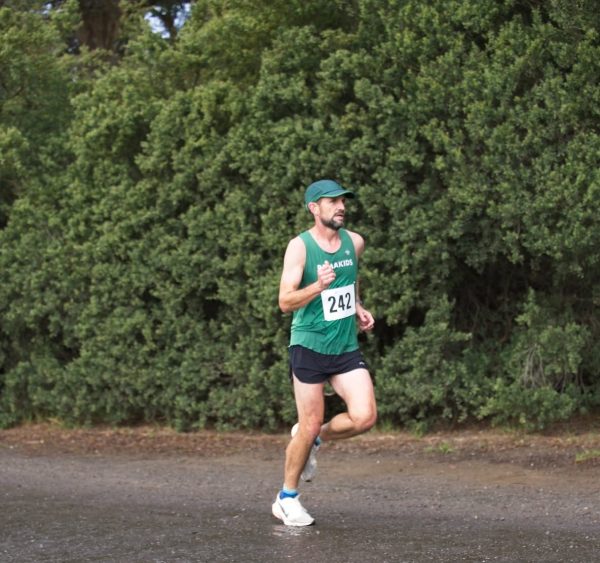
Drew Lindsey, my running mentor.
I was reminded how well this tool works in May. I was visiting my sister, Marta, in San Francisco. Her husband, Drew, was lacing up for a run, and I was jealous. I used to run quite a bit, but I had fallen out of practice – pretty much out of exercise altogether. Every time I wanted to start again, I would get injured.
I shared this with Drew, and he gave me excellent advice: take it slow. He recommended starting with walk/run intervals, even if I was mostly walking. He said not to worry about speed at all and just go super… duper… slow.
I took his advice. When I got back to LA, I started doing intervals around the Rose Bowl. Each interval was 6 minutes walking and 1 minute of what could barely be called jogging. It took me almost an hour to go around the 3-mile loop, but I wasn’t sore and was excited to return a few days later to do it again. Now, I’ve been doing the Rose Bowl 2-3 times a week for six months.
My goal was consistent exercise. Sprinting gets the heart rate up higher and burns more calories while you are doing it. Yet, in true tortoise/hare fashion, slower but consistent exercise beats a blown-out knee and months of recovery. This lesson has been echoed all over my work life.
Slowness was useful in the improv I performed professionally for years. One of my colleagues used to borrow from the Navy Seals by saying, “slow is smooth and smooth is fast.” When you rush an improv scene, like any conversation, it becomes harder to listen. You miss things. You are scattered. You speed through and then have to rewind and repeat in confusion. Instead, slow down. Connect with your partner, listen, respond, and build something together.
 The value of slowness was needed in the bustling restaurants where I worked in the early days of my acting career. There were always those servers who would run around hyper-stressed and try to do 5 things at once. That’s exactly when you ring in the wrong food, bring regular instead of decaf, or drop a tray of dishes on the floor. (Please don’t clap.) Instead, a seasoned server takes a deep breath and slows themselves down. They take a moment to scan their section so they can prioritize and delegate. Most importantly, they have to slow down to connect with the guest. Yes, everyone wants their gnocchi asap, but mostly they want to feel taken care of.
I hope you have noticed I have taken my time to share these examples before rushing to how you can apply slowness to nonprofit comms work. Here are a few places to start:
Slow stories. In last December’s issue of free range thinking, Jill Schwartz shared that her team’s work to tell stories for the Farm Bill at The Nature Conservancy had some surprising results. One of their rancher storytellers became an advocate, even speaking to Congress on behalf of the Nature Conservancy.
When Jill and I co-presented at ComNet this year, she said that a huge factor in creating their stories is that they don’t just meet their storyteller one time, drag all the info out they can, and move on. Jill and her team sit down with a storyteller multiple times to build trust, understand their story, and make sure what is being shared reflects their experience. adrienne maree brown calls this, “moving at the speed of trust.”

Slow Presentations. When given twenty minutes for a presentation, many of us try to cram in an hour’s (or lifetime’s) worth of content and talk as fast as we can to fit it in. We want the audience to know all the things! Unfortunately, too much information affects the audience negatively. They tune out, can’t follow, or get brain overload.
The space between thoughts is often where the audience absorbs what we say. I’ll pause while that sinks in…
Next time you have a time limit for your presentation, try going under on time. Your audience will likely get more if you say less.
Slow Meetings. In Meetings for People Who Hate Meetings, we spend a lot of time on constructing a solid agenda. One of the most common kinds of bad agendas is an overstuffed one. “Buckle up. We’ve got a lot to cover this week.” Putting everything on the agenda is a bad alternative to slowing down and prioritizing what the meeting must accomplish.
A streamlined agenda can increase your team’s focus, create less overwhelm, and help everyone better prepare in advance of the meeting.
We hope your mind is racing with other ways to put this in practice. (No wait!) We think it is best if you put this into practice… slowly.