In Case You Missed It: This month’s ICYMI was written by Andy Goodman in May 2012, as he sits down with story expert Lisa Cron to discuss audiences’ craving for stories.
I devour books about storytelling, and Lisa Cron’s Wired for Story: The Writer’s Guide to Using Brain Science to Hook Readers from the Very First Sentence is a meal and a half. I took copious notes starting on page one where I was stopped cold by this insight: “Story, as it turns out, was crucial to our evolution – more so than opposable thumbs. Opposable thumbs let us hang on; story told us what to hang on to.”
Cron currently teaches storytelling at the UCLA Extension Writers’ Program, and she honed her skills as a story consultant for Warner Brothers, the William Morris Agency, and other Hollywood institutions. Recently, we sat down to lunch in Los Angeles and talked about her new book.
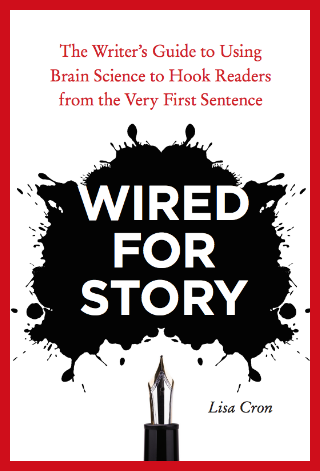 Goodman: I’ve read many books about the craft of storytelling, but this is the first I’ve seen that examines it through the lens of neuroscience. What got you interested in this kind of research?
Cron: For decades a big part of my job was to read manuscripts and screenplays and evaluate them. Most of them were really bad, so this almost always translated into figuring out why they didn’t work. It wasn’t long before I noticed something curious: while each story that didn’t meet my expectations crashed and burned in its own unique way, my expectations were few and constant.
A couple of years ago I began reading a bit of neuroscience just because it interested me. It was thrilling to discover that the expectations I’d identified corresponded with what the brain is wired to respond to in every story. The minute I saw the connection, I began devouring books, articles and studies in neuroscience, cognitive psychology and evolutionary biology.
Goodman: Wired for Story looks ideal for aspiring novelists and screenwriters, but how can it help non-profiteers who simply want to tell better stories about their work?
Cron: Story is story – whether it’s a novel, a screenplay, or the story of an organization, its mission, or how a problem it faces might be solved. When writing the book my goal was twofold. First, to help anyone who wants to communicate via story decode what a story really is and what people are wired to respond to in every story they hear. Second, I wanted to provide a hands-on method for creating a story that would meet those expectations every time. That’s something that would definitely benefit non-profiteers.
Goodman: What’s your definition of a “story”?
Cron: Great question, especially since people often mistake the story for the things that happen in it – the plot, the unfolding sequence of events. The plot is secondary. It is constructed to force the protagonist to deal with the inner issue – a mistaken belief, a misconception – that’s keeping her from achieving her goal. So what is a story? It’s how what happens affects someone who’s in pursuit of a difficult goal, and how he or she changes as a result.
Goodman: Your book makes the rather bold claim that all stories can be summed up in a single sentence: “All is not as it seems.” What do you mean by this?
Lisa Cron
Cron: Do you know what life is like when all is exactly as it seems? It’s boring as hell. When something is 100% predictable, it’s 100% boring and we pay no attention to it. Why should we? We already have it figured out. When something isn’t as it seems, we’re wired to notice it, lest it be something that could harm us (or help us). Stories are about making sense of, and navigating, the unexpected. What lures us in is the desire to find out what’s really going on. The sense of urgency we feel when our curiosity is piqued is actually a delicious dopamine rush that makes us pay attention.
Goodman: In chapter four, you cite research that shows how a good story will cause the audience to create mental simulations in their heads. Why is this important?
Cron: Stories are by definition mental simulations. When they’re not – they’re not stories. It’s that simple. When we’re caught up in a good story we’re feeling what it would be like to experience what the protagonist is going through. Think of story as the world’s first virtual reality. It lets us sit back and vicariously experience someone else suffering the slings and arrows of outrageous fortune, the better to learn how to dodge those darts should they ever be aimed at us.
Goodman: I love the Ernest Hemingway quote in your final chapter: “All first drafts are shit.” At first blush, that can seem discouraging, but you say it’s really liberating. How so?
Cron: Knowing that the first draft will probably suck helps silence that nagging, self- doubting inner critic we all have who’s always whispering, “really? That’s what you’re going to write? Are you sure?”
That said, it’s not a license for unbridled self-expression, or not to try hard from word one because it doesn’t really “count.” It does count, because it’s the raw material you’ll be working with, straying from, reshaping, paring, parsing, and then lovingly polishing. The goal of a first draft isn’t beautiful writing; it’s to come as close as you can to identifying the underlying story you’re trying to tell.
To learn more ways to hook audiences with your stories, register for our “Storytelling: Tapping the Power of Narrative” workshop on January 14, 21, 28 & February 4.