In Case You Missed It: This month’s ICYMI was written by Andy Goodman in November 2020. In it, he explores where there is room for improvement when it comes to accessibility for all in meetings.
Creating an inclusive atmosphere in which everyone present feels not only welcomed but valued can be challenging under the best circumstances. Remove the opportunities that come naturally when meeting in person – one-on-one chats, reading body language, sensing a group’s energy level – and it can feel almost impossible. In our report, “Unmuted,” which looks at the challenges videoconferencing presents, we heard this lament frequently from meeting leaders and facilitators.
Consequently, you might expect that those responsible for conducting videoconferences would use every tool and technique available to enhance inclusivity, and our research confirmed that they are…to some degree. But when it comes to using the tools specifically designed to include participants who may have difficulty seeing what’s being shown, hearing what’s being said, or fully understanding the language being spoken, most videoconferences miss the mark by a wide margin. Consider the responses below to a question in our survey about efforts to enhance accessibility:
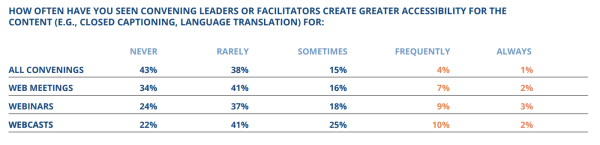
When only 12% of respondents reported that they observed webinar or webcast leaders “frequently” or “always” taking steps to create greater accessibility – and that’s the highest score across all categories of online convenings – clearly we are not prioritizing these activities. And what’s even more disappointing is that the most popular videoconferencing platforms all have a variety of accessibility tools readily available.
During the last week of October, we visited five videoconferencing platforms our survey respondents reported using most frequently to learn exactly which tools they provided. The built-in choices are abundant and include tools such as closed captioning, recordings with transcripts, high contrast mode, screen readers and magnifiers, and more. (Please note that the options available to your organization may vary with your level of service.) If you haven’t done so already, take the time to learn your options: here are links to the pages specifically dedicated to accessibility tools for Zoom, Webex, Microsoft Teams, GoToMeeting, and Google Meet.
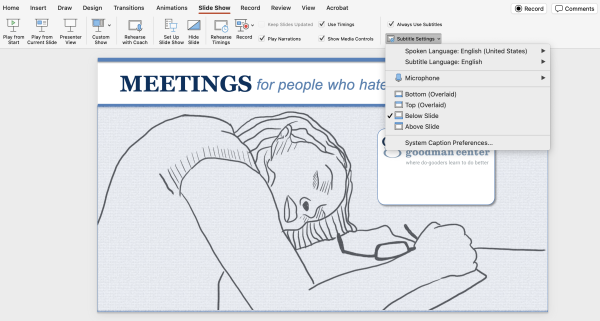
Your efforts at enhancing accessibility don’t have to end there. PowerPoint can increase accessibility when slides are part of your convening. Thanks to recent improvements by Microsoft, you can now set up your PowerPoint presentations to provide real-time subtitles for the speaker’s narration in either the speaker’s language or translated into any of 70 other languages. (And if you have access to PowerPoint Live Presentation, each audience member can can have the narration translated into the language of their choice.)
Two other resources to consider: U.S. government agencies are required by Section 508 of the Rehabilitation Act to ensure that communication materials such as PowerPoint slides are fully accessible to people with disabilities. Guidelines on text, object and color formatting and other design aspects can be found at www.section508.gov. And even if you don’t work for the government, these are useful standards for evaluating the accessibility of your slides.
Finally, WebAIM (an acronym for “Web Accessibility in Mind”) is a site maintained by the Center for Persons with Disabilities at Utah State University that offers training, consulting, evaluation and certification for organizations who are interested in enhancing the accessibility of all their web-based convenings and programs.
When meetings, presentations, trainings and just about everything you do move online, you face an entirely new set of challenges. How do you read the room when the “room” is a grid of faces on a computer screen? How do you keep remote workers engaged when the opportunity to multitask is constant? And how long can your team be productive when everything that was face-to-face is now conducted screen-to-screen?
To answer these and other equally daunting questions, we turned to the people at nonprofits and foundations, colleges and universities, and government agencies at all levels who are facing these challenges every day. Over 4,400 participated in our survey, and what they told us is summarized in our new report, “Unmuted: What works, what doesn’t, and how we can all do better when working together online.”
To learn more ways to make your meetings more inclusive, register for our “Meetings for People Who Hate Meetings” Workshop on May 13 & 15.