
In Case You Missed It! This article is from the February 2008 edition of our Free-Range Thinking Newsletter. ‘Tis the season for inspiring your supporters to make your organization is part of their giving. Here are our tips to create a clear, specific, and actionable ASK.
When public interest organizations reach out for support (financial or otherwise), it’s almost always advisable to forget about engaging “the general public” and focus on a more manageable audience closer to the heart of your cause. But that’s only step one.

Photo by Pixabay
With target audience in mind, you have to craft a message that will cut through the clutter, grab their attention, and pluck a heartstring or two. No easy feat, and even with that accomplished, your work is far from done.
Now you need to select spokespeople and choose media that will deliver your message with the utmost impact. And should you make the right choices at this stage, it’s still no guarantee of success. Because in the end, virtually every form of public out-reach comes down to the “ask,” that make-or-break moment when your audience — having stopped, looked, and listened — says, “So, what exactly do you want me to do?”
The right kind of ask can seal the deal, while the wrong kind can let your audience slip away. Here you’ll find classic examples of each, and they’re worth studying some time soon. Lessons learned here might just save your ask.
Take It Outside

To protect children from secondhand smoke, the Kansas Health Foundation (KHF) launched a campaign aimed at parents who smoke. The objective: reduce in-home smoking. The first hurdle that had to be crossed: parents believing their home is their smoke-filled castle. This ad was typical of the campaign and displays all the characteristics of a compelling ask:
Clear and easy to do. If you must smoke, do it outside.
Compatible with the audience’s values. Parents love their children, and smoking outside is positioned as an expression of that love.
Actionable now. Allow too much time between your ask and the audience’s opportunity to act, and your request will probably be set aside and forgotten. Moving smoking to the stoop or backyard can begin immediately.
Clearly makes a difference. Remove the smoke and you remove the hazard. You don’t need a PhD to understand the campaign’s premise.
Measurable. KHF was able to establish a baseline of public attitudes on smoking and monitor shifts as the campaign progressed.
Within three months, KHF was able to reduce by 50% the number of parents who still agreed with the statement, “I have a right to smoke in my own home.” A well considered ask was one reason for the campaign’s initial success.
Youth Smoking Prevention
As part of the Tobacco Master Settlement Agreement in 1998, Philip Morris was required to produce advertisements intended to reduce smoking among teenagers. This ad was part of the company’s Youth Smoking Prevention campaign. Note how the characteristics that make KHF’s ask so compelling are entirely absent here:
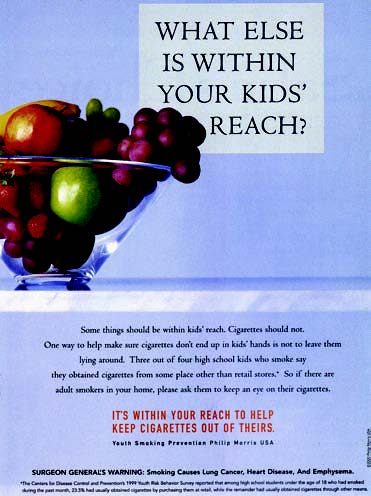
The ask is indirect and vague. “So if there are adult smokers in your home,” the body copy reads, “please ask them to keep an eye on their cigarettes.” This means the ad is not talking directly to the target audience and expects the reader to deliver its message. And that message — keep an eye on your cigarettes — is not exactly a clarion call to action.
The audience’s values are not engaged in a serious way. If you want parents to think about their children, which would you show: a child’s face staring right at you or a bowl of fruit?
The action can be taken now, but…
It’s not clear how it will make a difference. The red text reads, “It’s within your reach to help keep cigarettes out of theirs.” Fine. And…?
It’s not measurable in a meaningful way. Even if you could determine how many readers actually went
on to deliver the message, can you reasonably project any amount of reduced smoking among teens as a result?
Some critics have wondered if the ask is deliberately weak given that the advertiser is not genuinely invested in the campaign’s success. To which I must reply: do you really have to ask?
Do You Know the Four Connecting Points?
Every time you reach out, there are four potential points of connection between you and your target audience. When you know all four points and build your campaign around them, every minute and dollar you invest have a better chance of paying off. (“The Ask,” detailed in this issue, is connecting point #4.) Fail to connect on even one point, however, and you give your audience an opportunity to walk away. And don’t kid yourself: in this Age of Too Much Information, most people are looking for opportunities to tune out anything they can quickly categorize as noise.
If you like what you read here, you can learn about “The Four Connecting Points” in our Strategic Communications workshop on Dec. 5 & 7!